How Accurate Are AI-Generated Medical Narratives In Personal Injury Cases?

There has been an ongoing discussion among U.S. legal professionals regarding the use of AI to make a medical narrative report. AI has the potential to generate a medical report with technically correct data but often the document lacks logical flow, a proper case context and the kind of clarity attorneys require for settlement negotiations or trial.
The question that arises here is not about if AI can generate a medical narrative summary rather whether the output is reliable and generated according to the needs of an attorney and if it’s legally valid without human intervention. In this article, we discuss the accuracy of AI-Generated medical narratives and how they can make your PI cases efficient.
Can AI Create Accurate Medical Narratives For Injury Cases?
Artificial intelligence is changing the way every personal injury case is prepared. Law firms now prefer to use AI to process large volumes of medical records in a fraction of the time it once took. For tasks like creating a medical chronology, AI offers genuine speed and structural advantages.
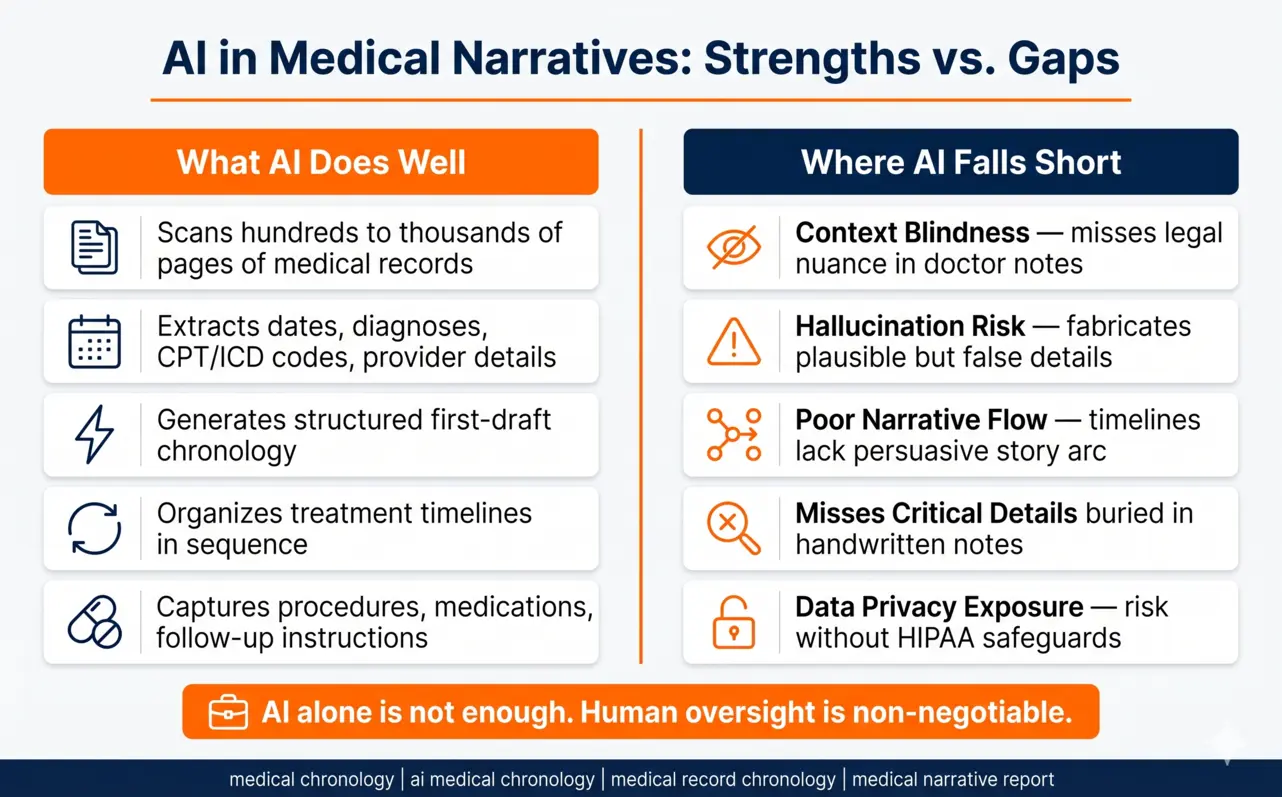
AI tools have the ability to scan hospital notes, lab reports, discharge summaries, and treatment records across hundreds or thousands of pages. They pick out information like key dates, diagnoses, procedures, and provider details, then put together this information to generate a medical record chronology. This gives attorneys a clean first demand letter draft to work from instead of starting from scratch.
When guided by trained virtual paralegals, AI can support high-quality medical chronology services by working on the heavy lifting of data extraction while humans manage accuracy and legal framing.
What Can AI Extract From Medical Records?
If you are trying to create or build an AI medical chronology, the techno-smart system can put out a variety of data points from medical files. Here is what it typically captures:
- Date of Service: The exact treatment date, which anchors the entire medical record chronology in the correct sequence
- Provider Details: Name, facility, and specialty of the treating doctor or clinic
- Chief Complaints: Symptoms the patient reported, helping establish the reason for each visit
- Diagnostic Findings: Results from MRI, X-ray, CT scan, and lab reports that highlight key medical findings
- Diagnoses With CPT and ICD Codes: Medical conditions noted along with billing and classification codes important for legal and insurance purposes
- Treatment Performed: Procedures, therapies, and medications stayed on each visit
- Follow-up Instructions: Post-care, doctor visits, and given medicine plans
- Delayed Treatment: Gaps between visits or missed treatments that may affect the claim’s narrative
- Changes in Health Condition: Notes indicating symptom improvement or deterioration over time
Such data, when put together correctly, forms the backbone of a strong system. The only challenge lies is that the output is not just structured but also accurate and legally sound.
Where AI Falls Short In Medical Narratives
AI medical chronology accuracy is improving rapidly, but the technology still has real limitations that matter significantly in personal injury litigation.
Context blindness is one of the biggest gaps. AI processes text literally. It does not interpret a doctor’s cautious wording, recognize when a handwritten note changes the entire picture, or understand the legal significance of a delayed diagnosis. A human paralegal reading the same record would flag these nuances immediately.
Hallucination risk is another concern. Some AI systems fill in gaps in records by generating plausible-sounding information that is not actually present in the source documents. In a medical narrative for a personal injury case, even a single fabricated detail can undermine the credibility of an entire claim.
Poor narrative flow is a structural issue AI struggles with consistently. A well-written medical narrative summary should dictate how the accident occurred, how the client was injured, what kind of treatment was given, and how the injury affected the person’s daily life in a story format. AI can produce timelines but can rarely produce a narrative with the persuasive arc attorneys need.
Missing critical details is perhaps the most costly risk. Important case-shaping facts are often buried in a brief handwritten note or a single line in a discharge summary. AI may skim past these while focusing on more structured data fields.
Data privacy exposure is also a legitimate risk. Medical records have highly sensitive patient information. If there are no proper safeguards and HIPAA-compliant handling, using AI tools induces real confidentiality risks that law firms must account for.
These gaps do not make AI useless. They make human oversight non-negotiable.
Do Attorneys Trust AI for Writing Medical Narratives?
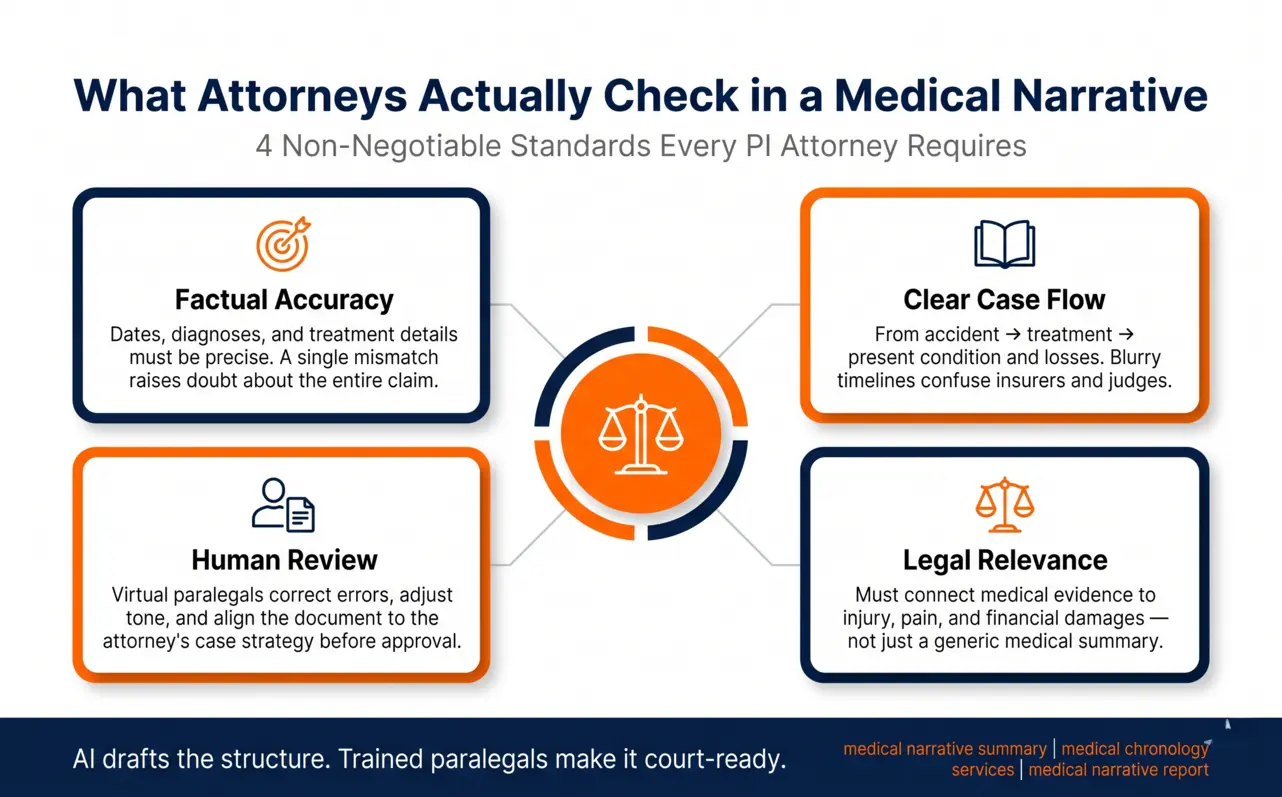
Most personal injury attorneys consider AI as a smart assistant, not an updated option for professional judgment. When reviewing an AI-generated medical narrative report, attorneys consistently look for four things:
Factual accuracy comes first. Dates, diagnoses, and treatment details must be precise. A single mismatched date or incorrect diagnosis code can raise doubt about the entire claim.
Clear case flow matters just as much as error-free work. The explanation should start from the accident through treatment and into the client’s present condition and losses. Blurry timelines make it harder for insurers and judges to follow the story.
Legal relevance shows a useful narrative and a generic medical summary separately. The document shows the connection between medical evidence and the injury, the pain, and the financial damages being claimed.
Human review is considered essential by virtually every attorney who uses AI in their practice. Virtual paralegals go through the draft, correct errors, change tone, and change the document as per the attorney’s case strategy before it ever reaches the final approval stage.
What Are the Risks of Using AI in Medical Narratives?
A tiny error in a medical chronology can make a huge difference to the perceived value of a personal injury claim. Here are the key risks to manage when using AI for medical narrative work:
Wrong medical details– A mismatched date or incorrect diagnosis can make an injury appear less severe or raise questions about when it actually occurred, weakening the claim before it reaches negotiation.
Missing important facts– Critical information unnoticed from small notes or brief doctor comments may be ignored by AI, missing out details that could strengthen the case.
Made-up information– When AI is used to fill in missing data for a complete-sounding narrative, it introduces absurd content that could damage the authenticity of the entire case if discovered.
Poor case flow– A scattered medical narrative summary makes it harder for legal teams, insurers, and courts to make out what happened and how the injury affected the client’s life.
Data privacy risks– In case of no proper safeguards, confidential patient information in medical records can be accessed or used in ways that violate confidentiality requirements.
These risks can be taken care of only with the right combination of AI tools and trained human oversight.
Why Human and AI Collaboration Works Best in Legal Support
The most effective approach to AI medical chronology work is not AI alone. It is AI combined with trained offshore virtual paralegals who understand both medical terminology and personal injury law.
Here is how the model works in practice. AI handles data extraction, initial organization, and timeline structuring, which is the time-intensive work that does not require legal judgment.
Offshore paralegals then re-check the output for mistakes, fill in missing context, correct errors, make narrative flow naturally, and format the final document as per the attorney’s specifications. The attorney gets a polished, ready-for-court medical narrative report just needing a final review and approval.
This approach shows the speed of AI with a human touch, and at a cost that in-house paralegal staffing cannot match.
What Changes When a Paralegal Reviews AI Output
| Feature | AI Only | AI + Offshore Paralegal |
| Accuracy | Moderate- prone to hallucinations and missed context | High- human review catches errors and fills gaps |
| Narrative Quality | Structural but often lacks well-connected points | Polished, attorney-ready, and case-specific |
| Turnaround Time | Very fast | Fast with added review layer |
| Legal Relevance | Limited — AI lacks case strategy awareness | Strong — paralegals align content with legal goals |
| Data Privacy | Dependent on tool compliance | Managed with proper HIPAA-compliant protocols |
| Cost Efficiency | Low upfront, high revision cost | Cost-effective with fewer attorney corrections needed |
| Court Readiness | Rarely ready without revision | Reviewed, formatted, and submission-ready |
The offshore paralegal model gives attorneys the best of both worlds: the efficiency of AI medical chronology tools and the reliability of professional human judgment.

Frequently Asked Questions
Can AI replace a paralegal for medical chronology?
Not entirely. AI can speed up data extraction and initial organization of a medical record chronology, but it lacks the legal judgment, contextual understanding, and attention to nuance that trained paralegals provide. AI works best as a tool that paralegals use, not a replacement for them. The most reliable medical chronology services combine both for accuracy and efficiency.
Is an AI-generated medical narrative admissible in court?
AI-generated content itself is not automatically admissible or inadmissible. What matters is accuracy, authenticity, and how the document was prepared and verified. A medical narrative report drafted with AI assistance but reviewed, corrected, and signed off by a legal professional carries the same evidentiary weight as any other professionally prepared document. Attorneys must ensure all facts are verified before submission.
How do offshore paralegals use AI for medical chronologies?
Offshore virtual paralegals use AI tools to read large volumes of medical records quickly, pull out dates, diagnoses, treatments, and provider information. They then review the AI output for errors, missing details, and narrative gaps.
The content goes through restructure as needed, the attorney’s preferred format is applied and a complete, reviewed medical narrative summary is delivered. This workflow dramatically reduces turnaround time while maintaining professional quality standards.
Conclusion
AI is a smart option for creating medical chronologies and drafting initial medical narrative reports. It reads large files quickly, organizes events in order, and creates structured first drafts that save attorneys significant time. But AI alone is not enough. It misses context, can generate inaccurate content, and does not understand the strategic needs of a personal injury case.
The solution is pairing AI with trained professionals who do.
At LPO Giant, we combine advanced AI with experienced offshore virtual paralegals to deliver medical chronology services that are thorough, accurate, and court-ready. Every medical narrative summary we make is checked by legal professionals who understand what attorneys need and how cases are won. You get faster turnaround, stronger narratives, and more time for your team to focus on strategy.
Start your Pilot Project today and experience the LPO Giant difference firsthand.

Try Free Pilot Project