How Virtual Litigation Support Helps Personal Injury Attorneys Win More Cases


Winning more cases for personal injury attorneys is not only about courtroom confidence or negotiation skills. Stronger results often begin much earlier, when the file is organized, the medical story is clear, the damages are well supported, and the attorney can quickly find the right facts without searching through hundreds of pages.
That is where virtual litigation support becomes valuable. It provides PI firms with remote, attorney-directed assistance for records, summaries, timelines, demand packages, document review, and case preparation, allowing attorneys to spend more time on strategy instead of repetitive documentation work.
For firms handling high-volume injury matters, personal injury paralegal services help move cases forward without adding pressure to in-house teams. In this article, we explain how virtual litigation support helps personal injury attorneys organize medical evidence, reduce delays, strengthen demand packages, and improve case outcomes.
Role of Virtual Litigation Support in Personal Injury Law Firms
Virtual litigation support is remote legal support for the practical work that helps attorneys prepare cases. In personal injury practice, it usually includes medical record summaries, medical chronology services, medical indexing, demand letter drafting, exhibit organization, document review, discovery support, and case status summaries.
The virtual support team does not replace attorney judgment. It prepares organized, review-ready work so the attorney can evaluate liability, causation, damages, negotiation position, and litigation strategy faster.
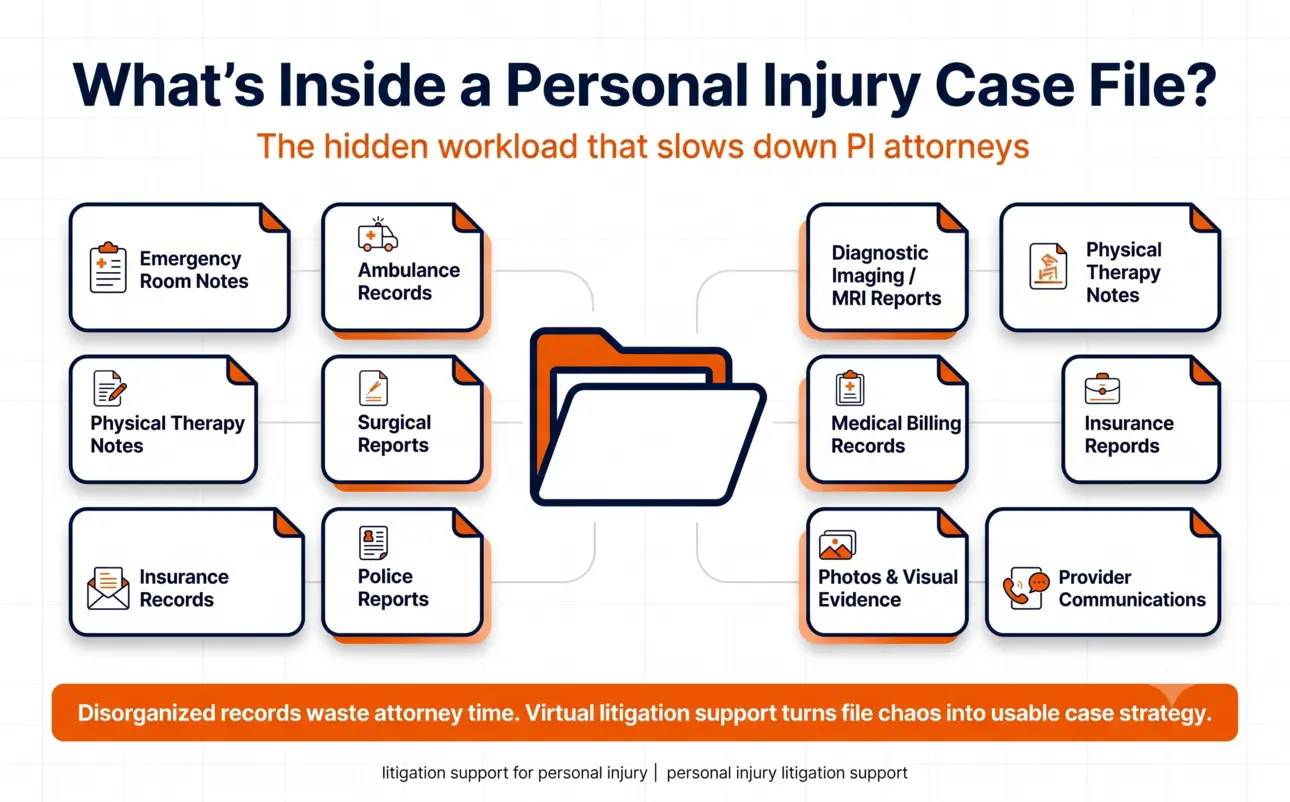
A typical personal injury file may contain emergency room notes, ambulance records, diagnostic imaging, physical therapy notes, surgical reports, billing records, insurance correspondence, police reports, photographs, and provider communications. When these documents are scattered, the attorney loses time. When they are organized into a usable timeline and index, the legal strategy becomes easier to build.
Why Personal Injury Attorneys Need Better Litigation Support
The biggest workload problem in PI firms is often not the lack of legal knowledge. It is the volume of detail inside every file. One case may have only a few treatment visits. Another may involve months of care, multiple providers, disputed causation, and thousands of pages of records. Attorneys need to understand the medical facts before they can negotiate effectively, prepare a demand package, or decide whether a case should move toward litigation.
That is why litigation support for personal injury must be more than basic admin help. A support team should know how to read medical records, organize treatment dates, identify missing documents, summarize important facts, and flag inconsistencies for attorney review. Done well, medical chronology services give attorneys a structured view of the case instead of a pile of disconnected records.
How Virtual Litigation Support Turns Records Into Case Strategy
Medical records are only useful when the attorney can quickly understand what they prove. A virtual support team can review the file and capture the information that matters most: date of service, provider, complaint, diagnosis, treatment, test results, prescriptions, referrals, restrictions, billing details, and future-care notes. That information can then be converted into a medical chronology, medical summary, or case review memo.
This process helps attorneys answer important questions. Was treatment consistent? Is there a gap in care? Are all providers accounted for? Do the records support the claimed injury? Are there missing bills? Is there objective imaging? Are the damages easy to explain? These are practical questions that affect settlement posture and trial preparation.
Good medical indexing services also make the file easier to navigate. Indexed records, bookmarked PDFs, and clear document names reduce wasted review time. Instead of opening every file to find a discharge summary or MRI report, the attorney can move directly to the relevant document.
What Tasks Can PI Attorneys Outsource?
Personal injury firms do not need to outsource every task. The best approach is to delegate repeatable, document-heavy work that slows the attorney or internal team. Common personal injury litigation support tasks include:
| Task | How It Helps Attorneys |
| Medical chronology | Builds a clear treatment timeline |
| Medical record summary | Highlights key facts without rereading every page |
| Medical indexing | Makes large record sets easier to review |
| Demand letter drafting | Speeds up settlement package preparation |
| Legal document review services | Helps find missing facts and inconsistencies |
| Exhibit organization | Supports mediation, arbitration, and trial prep |
| Case status summaries | Keeps attorneys updated on file progress |
Sensitive medical information must be handled carefully. The U.S. Department of Health and Human Services explains that the HIPAA Privacy Rule protects protected health information held or transmitted by covered entities and business associates in any form or medium.
Firms working with outside support should use secure access, limit file permissions, and maintain clear confidentiality expectations. See the HHS HIPAA Privacy Rule summary for background on protected health information.
How Virtual Litigation Support Strengthens Demand Packages
A demand package is stronger when the evidence is easy to follow. Before an attorney can present liability, injuries, medical treatment, damages, and settlement value, the supporting records need to be complete and organized. That is why virtual litigation support and demand letter drafting work closely together.
A support team can prepare the record foundation before the attorney finalizes the legal argument. This may include medical summaries, billing summaries, treatment timelines, exhibit lists, missing-record notes, and draft demand language. The attorney then reviews the facts, applies legal judgment, adjusts strategy, and approves the final package.
When the file is organized, the demand letter becomes easier to write and easier for the recipient to evaluate. A well-supported demand package can reduce confusion, limit back-and-forth over basic facts, and help the attorney present damages with more confidence. For firms that need drafting help, demand letter drafting services are a natural extension of medical record organization.
How Virtual Support Helps Attorneys Win More Cases
No support service can guarantee a case outcome. But better preparation can improve the attorney’s ability to negotiate, respond, and litigate. Virtual litigation support helps attorneys win more effectively by reducing friction in the case-preparation process.
First, it gives attorneys more time for strategy. Instead of spending hours naming files, extracting treatment dates, and building summaries, attorneys can focus on liability, damages, negotiation posture, client counseling, deposition preparation, and trial decisions.
Second, it makes important facts easier to use. A support team can flag treatment gaps, missing imaging, inconsistent complaints, high-value future-care notes, unpaid medical bills, or unclear causation references. These details may change how the attorney values the claim or prepares the demand.
Third, it helps the firm manage more cases without sacrificing consistency. As caseload grows, documentation grows with it. virtual paralegal services give firms flexible capacity during high-volume periods, without forcing every workload spike into a full-time hiring decision.
Virtual Litigation Support vs In-House Staff
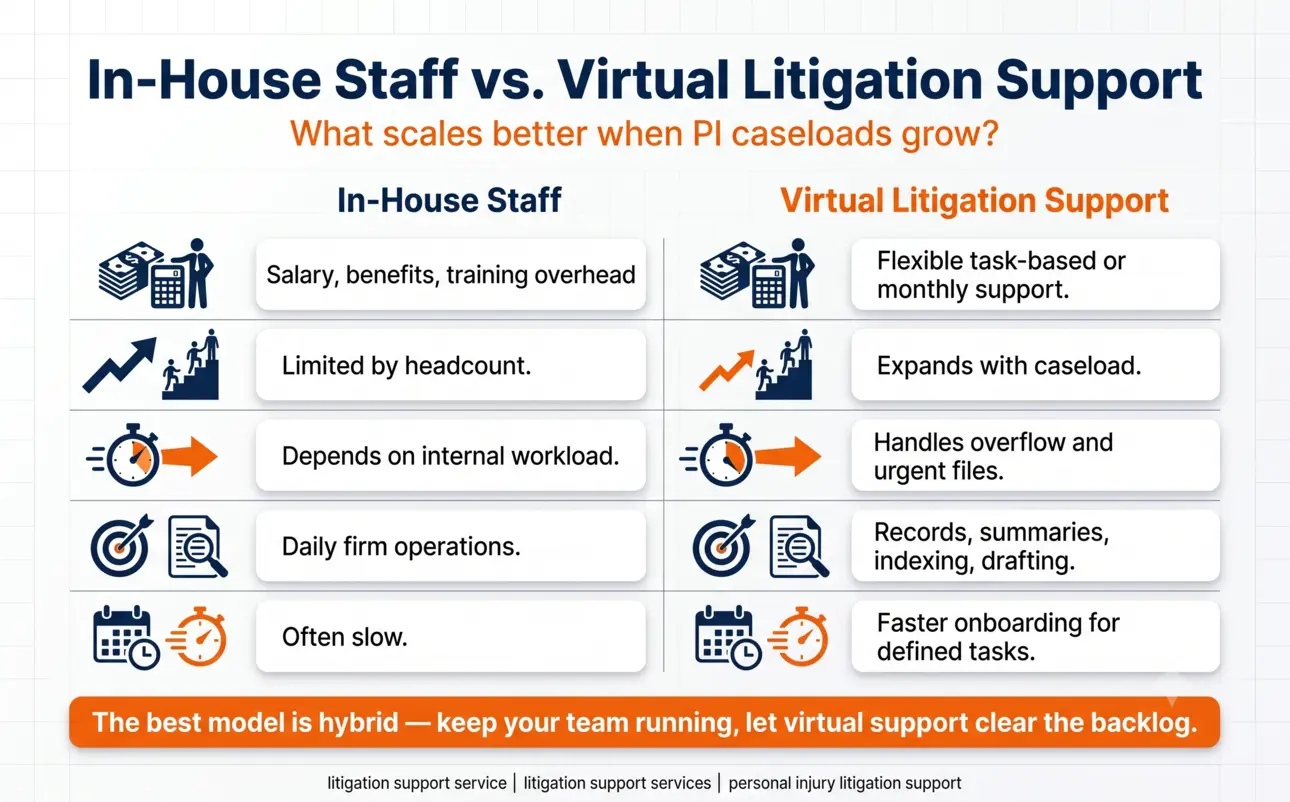
Virtual support is not always a replacement for in-house staff. In many PI firms, it works best as an extension of the internal team. The in-house team may handle client communication, intake, calendar management, attorney access, and daily priorities. The virtual team can focus on record-heavy work that requires time and concentration.
| Factor | In-House Staff | Virtual Litigation Support |
| Cost | Salary, benefits, training | Flexible task-based or monthly support |
| Scalability | Limited by headcount | Can expand with caseload |
| Turnaround | Depends on internal workload | Useful for overflow and urgent files |
| Focus | Daily firm operations | Records, summaries, indexing, drafting |
| Hiring speed | Often slow | Faster for defined tasks |
The best model is usually hybrid. Attorneys keep control. Internal staff keeps the firm running. Virtual support clears the documentation backlog.
Security and Quality Control Matter
Because PI files often include medical and personal information, security should never be treated as an afterthought. A reliable support provider should use secure file transfer, controlled access, confidentiality procedures, and a clear review process. The HHS Security Rule focuses on safeguards for electronic protected health information, which is a useful reference point for firms building secure record-sharing workflows. The HHS HIPAA Security Rule summary explains the broader security framework for electronic health information.
Quality control is just as important as security. A provider should be able to explain how work is reviewed, how missing records are flagged, how attorney preferences are followed, and how revisions are handled. Fast work is useful only when the output is accurate, organized, and ready for attorney review.
Best Workflow for Using Virtual Litigation Support
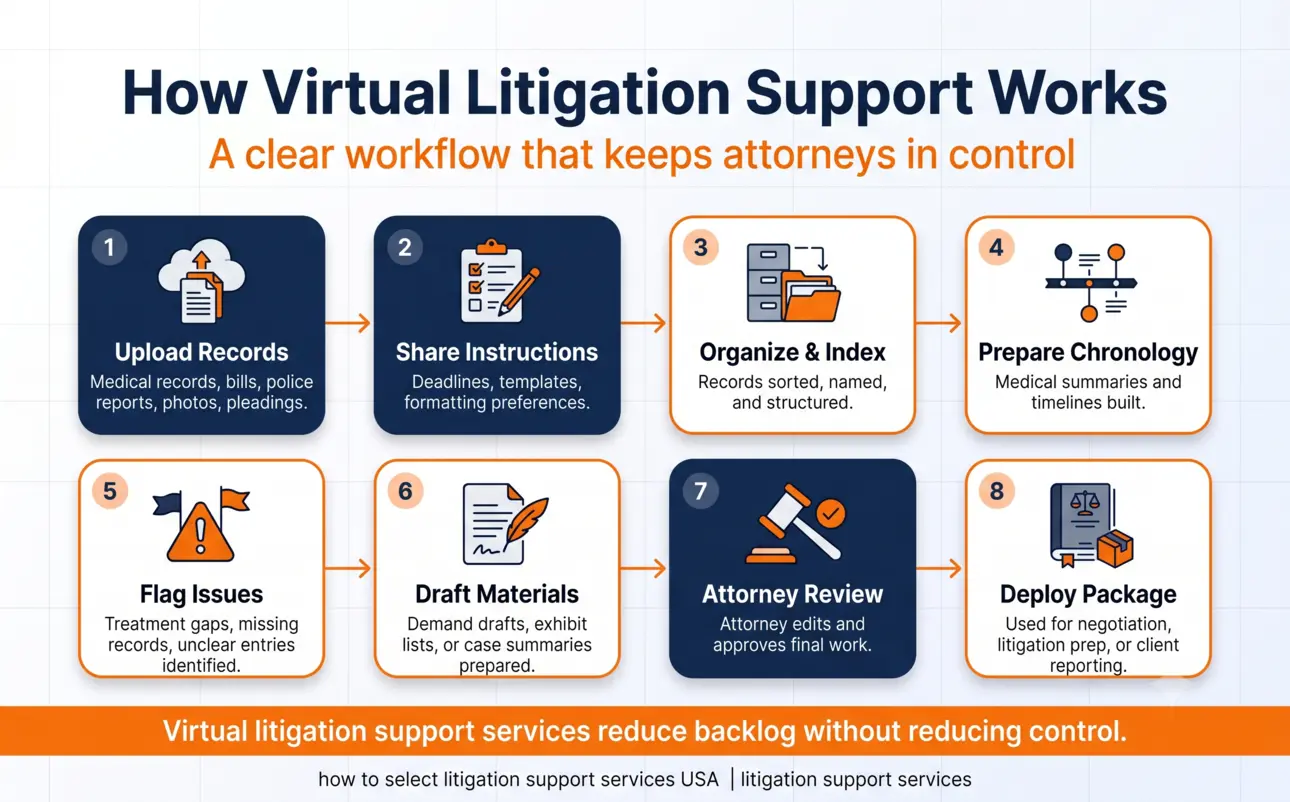
A simple workflow helps PI firms get better results from outsourcing:
- Upload medical records, bills, police reports, photos, pleadings, and prior notes.
- Share attorney instructions, deadlines, templates, and formatting preferences.
- The support team organizes, indexes, and names records.
- The team prepares medical record summaries or a medical chronology.
- Missing records, treatment gaps, and unclear entries are flagged.
- Draft demand materials, exhibit lists, or case summaries are prepared.
- The attorney reviews, edits, and approves the final work.
- The final package is used for negotiation, litigation preparation, or client reporting.
This process keeps the attorney in control while reducing the time spent on repetitive document work. Firms that want to understand how organized chronologies affect negotiation can also review this related post on how medical chronology helps case settlement.
Common Mistakes Law Firms Should Avoid
The first mistake is outsourcing without instructions. A support team needs templates, sample outputs, deadlines, and attorney preferences. If the attorney wants a specific chronology format or demand letter style, that should be shared at the beginning.
The second mistake is waiting until the case is already delayed. Virtual support works best when record organization starts early, not after the demand package is overdue.
The third mistake is sending incomplete records and expecting a complete summary. A good provider can flag missing items, but the firm should still send the most complete file available.
The fourth mistake is treating support work as final legal work. Virtual teams prepare attorney-ready drafts and summaries. The attorney still reviews, revises, approves, and makes legal decisions.
FAQs About Virtual Litigation Support
What is virtual litigation support?
Virtual litigation support is remote, attorney-directed help with case preparation tasks such as medical chronology preparation, record summaries, demand drafting, document review, indexing, discovery organization, and exhibit preparation.
Can personal injury attorneys outsource medical chronology preparation?
Yes. PI attorneys can outsource medical chronology services to trained support teams, as long as the attorney supervises the work and reviews the final product.
Does virtual support replace an in-house paralegal?
Usually, no. It often supplements in-house staff by handling overflow, record-heavy work, summaries, indexing, and drafting support.
What should PI firms outsource first?
The best first tasks are usually medical chronologies, medical indexing, medical record summaries, demand letter drafting, and legal document review services.
Conclusion
Virtual litigation support helps personal injury attorneys turn disorganized records into usable case preparation. It supports stronger timelines, cleaner summaries, faster demand packages, better document review, and more efficient settlement preparation.
The value is not that virtual support replaces legal strategy. The value is that it gives attorneys more time for legal strategy. When the records are organized and the facts are clear, attorneys can evaluate damages faster, negotiate with better support, and keep cases moving instead of letting files sit in the backlog.
For PI firms dealing with staff overload, delayed demand packages, or growing record volume, attorney-directed personal injury litigation support can create a more scalable workflow. LPO Giant also supports broader legal process services for law firms that need flexible help across practice areas.

Try Free Pilot Project