
What Are Remote Paralegal Services and How Do They Work for Law Firms?


The legal industry is seeing a huge transformation. There is a sudden rise in overhead costs, increasing client demands for faster turnarounds and markets are getting competitive. This is making law firms rethink staff intake and their firms’ working methods. However, the trending solution to all of this across the country is remote paralegal services.
The number of U.S. paralegals has increased by 360,000, with professionals now operating as either virtual or independent practitioners. When you look at the legal outsourcing market, it’s estimated to grow from $21.68 billion in 2025 to over $155 billion by 2035, having an average growth rate of over 16%.
In this blog, we will explain what remote paralegal services are, how they work day-to-day, the core benefits, which tasks are best suited for remote support, and how your firm can get started the right way.
How Remote Paralegal Services Actually Work on a Day-to-Day Basis?
Remote paralegal services, also termed as virtual paralegal services or paralegal services online, are professional services in which a trained paralegal helps run your law firm, sitting in a remote location but working under the direct supervision of a licensed attorney. Those paralegals can be freelance contractors, members of a virtual staffing agency, or staff of a specialised legal process outsourcing firm.
ABA guidelines and state bar rules treat paralegals as non-lawyer assistants who do the substantive legal work under the attorneys’ supervision. They have no right to give legal opinions, decide fees, or even establish attorney-client relationships. These responsibilities are always of the licensed lawyer.
In practice, this is how a typical remote paralegal workflow looks like:
- Onboarding: You begin by signing an agreement, setting up privacy and confidentiality rules, deciding what work should be assigned, just like how to take up new cases.
- Secure system access: The remote paralegal gets safe and restricted access to your case management software, document and communication tools through secured cloud platforms.
- Task assignment: Attorneys usually send work through email, project management tools, or your case management system. Mostly, the turnaround time is agreed upfront. Regular tasks are often instructed to be completed within 24 to 48 hours.
- Supervision and review: It’s the supervising attorney who reviews the work before it is finalized or filed, taking full responsibility under ABA Model Rule 5.3.
- Flexible billing: Payments are made on an hourly, project-based, or subscription model, i.e., you only pay for actual work done, not idle time.
You can assume a remote paralegal to be the bluetooth extension of your team who works with your tools and adjusts according to your firm’s workflow.
What Makes Remote Paralegal Services Different From Traditional In-House Paralegal Support?
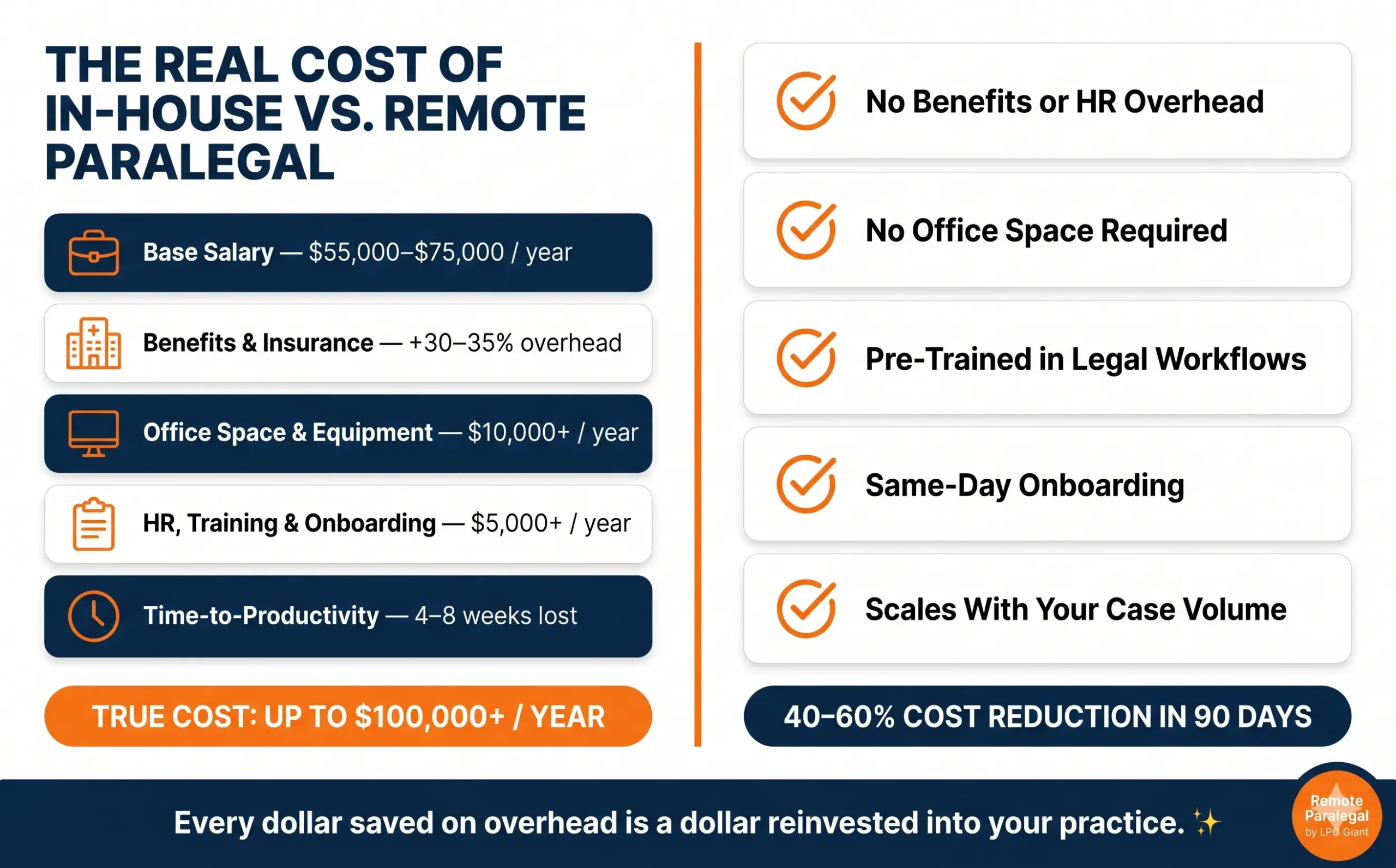
The actual differences come down to structure and cost. An in-house paralegal is your firm’s employee. You are responsible for their salary, benefits, payroll taxes, office space, equipment, and training, all fixed costs that stay even when you have a less caseload.
The Real Cost of an In-House Paralegal
If you check the median salary of a U.S. paralegal, it will tentatively cost you somewhere between $60,000 to $70,000. With the add-on benefits (generally between 20 to 30% additional to base salary), office space, equipment, and training, the actual yearly cost of a full-time in-house paralegal can easily be $85,000 to $100,000 per year.
But remote paralegal services providers charge you only $25 and $75 per hour, depending on the provider, practice area complexity, and experience level, which can be a minute fraction of those annual costs for many firms.
Flexibility and Scalability You Cannot Get In-House
Apart from cost, remote services give you another big advantage: scalability. If there is a sudden rise in your caseload during trial prep or a busy filing season, you can ask for support immediately.
When your caseload decreases, you can scale back without any HR complications. Many virtual paralegal providers also maintain teams that have a diverse practice-area experience including litigation, corporate, real estate, and immigration.
It’s because a single service can cover multiple legal specialties that might otherwise require several different hires. However, there are no separate rules for a paralegal who works remotely and the supervising attorney is responsible for the quality of every work.
The Core Benefits of Using Online Paralegal Services
The behind-the-scenes of a law firm carries a long list of paperwork that eats up valuable time. But with online paralegal services, attorneys find it much easier to complete the tasks within the given deadline.
Here is why many U.S. attorneys are opting for remote paralegals:
- Significant cost savings: Law firms that give routine paralegal work to remote providers have seen 30%-50% reduction in costs primarily because of eliminating office space, equipment and benefit expenses.
- Flexible, scalable staffing: It’s allowed for law firms to scale up during busy periods and scale down when it is slow, without retaining headcounts through months of no work.
- Access to specialized talent: Virtual paralegals bring with them niche expertise in areas like e-discovery, mass torts, and corporate compliance, skills that smaller firms can’t afford to hire full-time.
- More billable hours for attorneys: Studies have proven that attorneys spend up to 40% of their time on administrative and paralegal-level tasks that could be outsourced. Offloading that work through a remote paralegal service can definitely increase an attorney’s billable output each week.
- Faster client response times: Remote teams working in different time zones can keep working on the case even outside your regular office hours, which can have a positive impact on client satisfaction and retention.
Which Tasks Are Best Suited for Remote Paralegal Services?
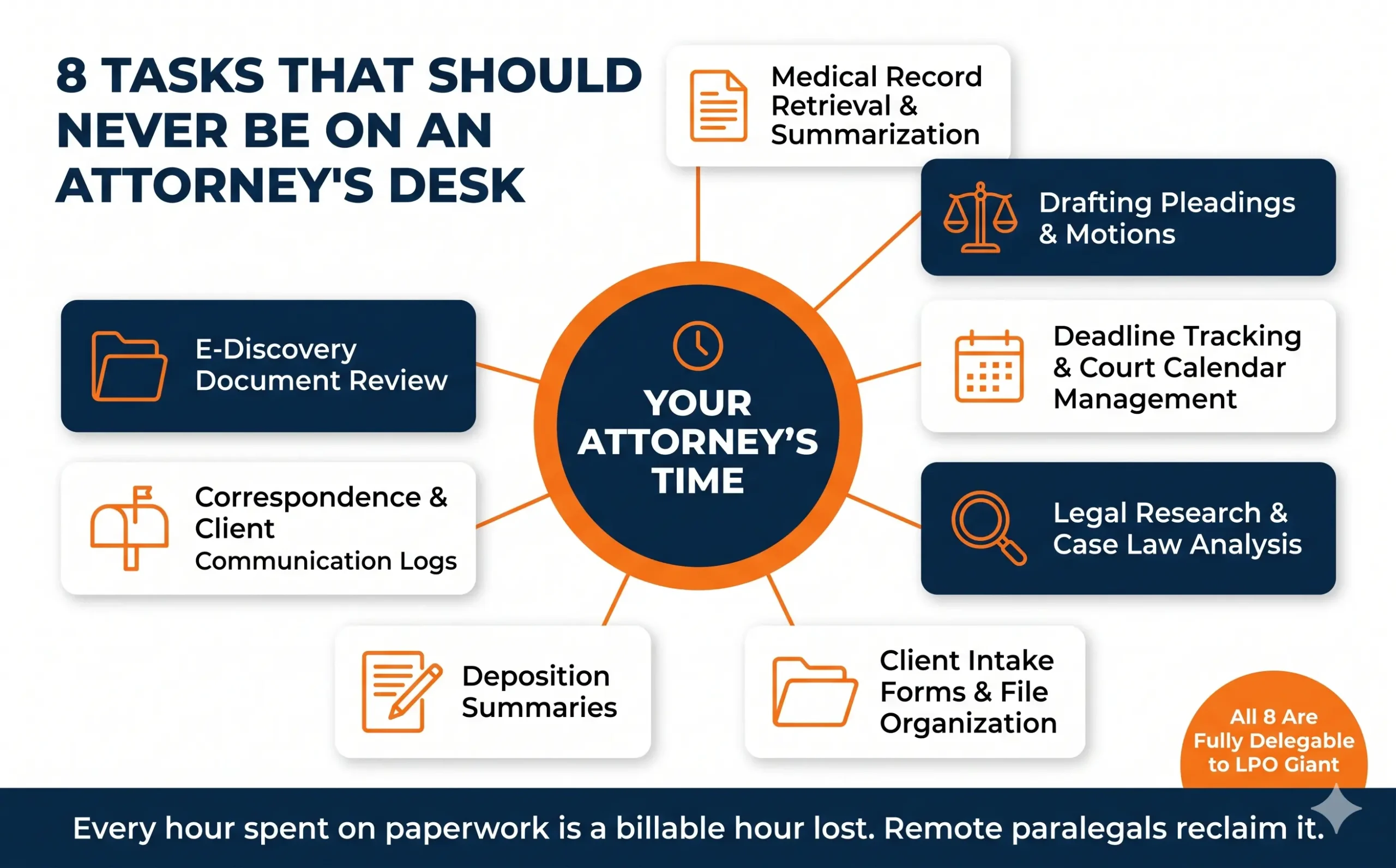
Not every task can be done by a remote paralegal, apart from the most time-consuming legal functions, under proper attorney supervision. Some tasks that can be best done by a remote paralegal are given below.
- Legal research and writing: A remote paralegal can help with case law research, statute analysis, memo drafting, and motion support and the attorney directs the legal issues and reviews the final work. If your hire is a skilled remote paralegal, be assured of getting a well-organized research memo in 4-8 hours.
- Document preparation and review: They also work on drafting pleadings, discovery requests and responses, corporate filings, standard agreements, and even client letters following your firm’s default templates.
- Litigation and discovery support: Virtual paralegals can organise case files, manage document production, coordinate exhibits, summarize depositions, and track deadlines. In case of a large discovery, remote paralegals can help review hundreds of documents per day, freeing an attorney’s time and reducing the associated costs.
- Client intake support: If given proper training and supervision, a remote paralegal can even manage initial intake questions and collect background information, consistent with ABA Formal Opinion 506 guidance.
- Back-office and compliance tasks: They can do entity maintenance, basic due diligence summaries, and internal policy documentation, but the attorney must retain control of final advice and filings.
There’s one thing that remote paralegals should not end up doing. They cannot independently establish attorney-client relationships, set legal fees, or provide legal opinions. Those responsibilities fall into the hands of licensed attorneys under both ABA and state rules.
Who Should Consider Using a Remote Paralegal Service?
Remote paralegal services are not a one-size-all-purpose solution. They work across a wide range of firm profiles, some of which are given below;
- Solo and small firm attorneys: A remote paralegal helps you save money by turning a fixed salary into a flexible cost so that your firm can handle heavy documentation work without the worry of expenses.
- Growing mid-size firms: Virtual paralegals always explore new practice areas, learn to manage a sudden spike in caseload, before entering new markets or working under a permanent hire.
- Large firms and corporate legal departments: They can take care of extra cases, support big litigations, or even work on specialized tasks like complex discovery or regulatory tracking without needing you to hire extra headcount.
- High-volume practice areas: Legal areas like personal injury, immigration, consumer protection, and mass torts, having a regular heavy intake workflow and standardized documents, can be done error-free with remote paralegal support.
Just incase, you find fluctuating caseload, rising overhead or trouble in hiring a qualified paralegal, a pilot project offered by remote paralegals is worth trying.
Remote Paralegal Service vs. In-House Paralegal: A Side-by-Side Look
| Factor | Remote Paralegal Service | In-House Paralegal |
| Annual cost | $25 to $75/hour; excluding benefits or overhead; average annual costs are $15,000 to $50,000 as per usage | $85,000 to $100,000+ per year; inclusive of salary, benefits, space, and equipment |
| Flexibility | Easy to scale up or down with caseload needs; changes can happen within days | Slow to adjust; hiring and offboarding carry HR, legal, and cultural implications |
| Talent access | Broad geographic pool including niche specialists; not limited by your local market | Primarily limited to local candidates; niche skills can be hard to find in smaller markets |
| Turnaround time | Standard tasks completed within 24 to 48 hours; complex work varies by scope | Immediate availability on-site but capacity limited to one person’s bandwidth |
| Supervision | Remote supervision required; lawyer retains full ethical responsibility under ABA and state rules | On-site informal oversight; same underlying ethical obligations apply |
| Best for | Overflow work, specialized tasks, high-volume processes, and growth phases | Core daily operations, sensitive matters, and roles requiring heavy in-person client interaction |
The smartest choice for many firms can be a hybrid model: a small in-house team supported by remote paralegals that take things light and handle multiple cases, specialized work, and be cost-effective.
How to Get Started With Remote Paralegal Services to Scale Your Law Firm
If you wish to explore remote paralegals, you can go by the steps mentioned below and get started the right way:
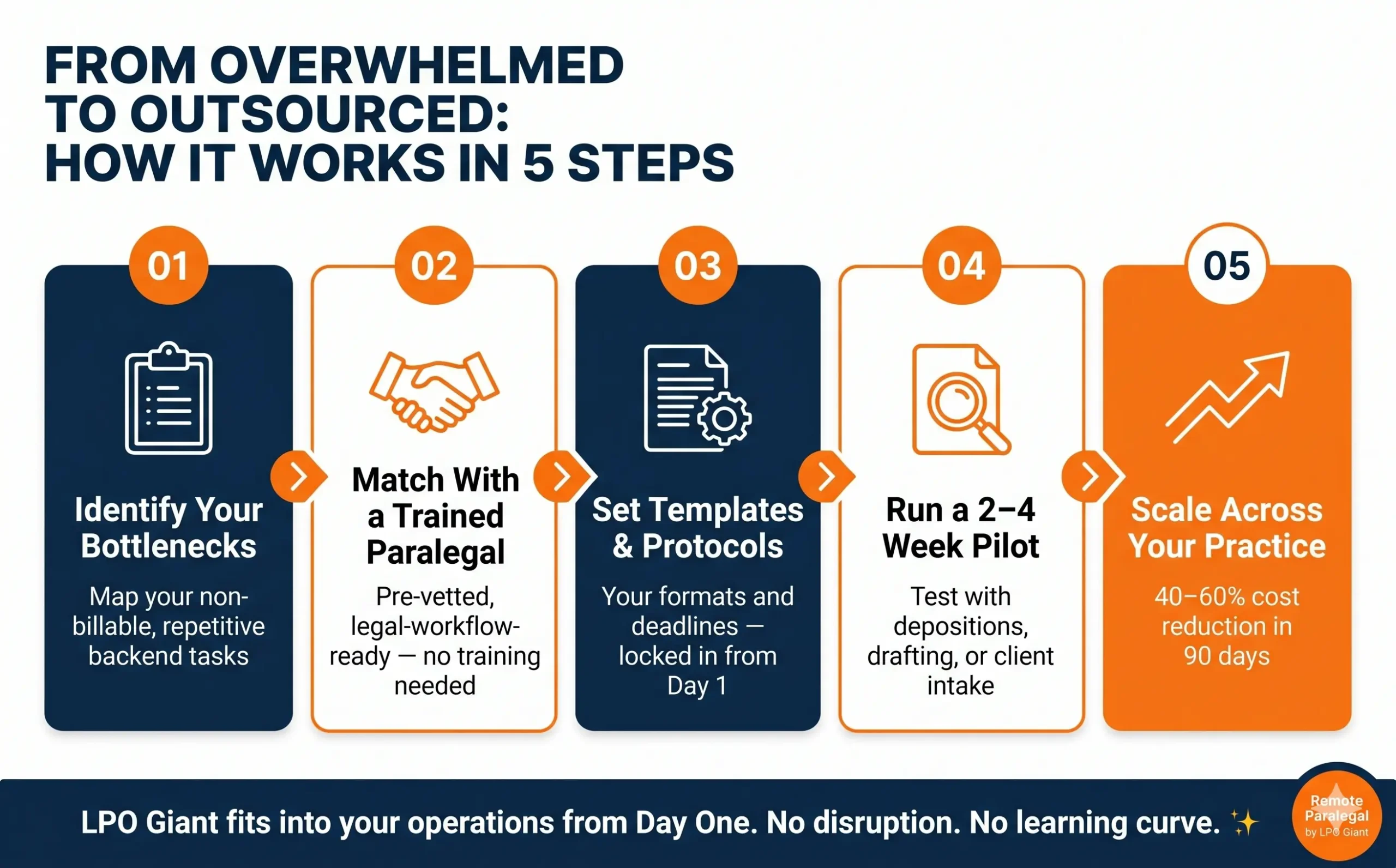
- Audit Your Workload: Figure out the tasks that are consuming much of your time which can be research, drafting, intake, and discovery, and calculate the hours per week you would like to outsource.
- Review The Ethical Rules: Read the state bar’s guidelines for nonlawyer assistants and ABA Model Rule 5.3 so that you know what legal boundaries you have.
- Choose The Right Provider: Select between a freelance virtual paralegal, a specialized remote paralegal firm, or a full-service LPO service provider whichever is comfortable for your budget, workload, and practice-area needs.
- Very Carefully: Inquire about their practice-area experience, go through their sample work products, understand the data security protocols, malpractice coverage, and how the provider deals with conflicts and confidentiality.
- Define Your Workflow Upfront: Create a written document detailing the work, get a good understanding of the task-assignment procedures, agreed turnaround times, and review checkpoints so the remote paralegal knows what they can and cannot handle independently.
- Start With A Pilot: You can try out a Trial Pilot in one practice area or a particular set of matters for 30-60 days. Use that pilot to change your templates, communication protocols, and supervision routines.
- Track Performance And Adjust: Calculate the turnaround time, quality, cost per case, and attorney satisfaction. If something is not right, adjust your expectations accordingly.
You need to treat your remote paralegal service like a professional vendor relationship and you will see a huge growth in your investment. Firms that have defined expectations and proper monitoring systems consistently see better results.
Conclusion
Remote paralegal services offer U.S. attorneys and law firms a smart and professional path to take up more cases without the need to hire extra in-house support. Be it legal research, documentation, discovery support or a client intake work, paralegal services online can work as an extended helping hand. They make sure to free up attorneys so that all the work that can only be completed by them is done.
Law firms that are No.1 cannot be labelled as the largest but the most efficient ones. If a firm spends $25 to $75 per hour giving no extra benefits, no hiring more staff, smartly scaling only when the demand is high to a reliable remote paralegal service, that’s the biggest investment a clever and profit-oriented law firm can do right now.
At LPO Giant, we help law firms and attorneys scale efficiently with reliable, fast, and accurate remote paralegal services. Our experienced virtual paralegals support legal research, document drafting, discovery, client intake, and back-office legal work, so your attorneys can focus on case strategy, client service, and billable work.
Try a Free Pilot Project and Experience the Difference.

Try Free Pilot Project