
How Virtual Paralegals Handle Case Management Efficiently For Law Firms?


Paperwork didn’t pile up overnight, but for many U.S. law firms, it started feeling that way as filings increased. Nearly 60–65% of legal work depended on in-house teams, while paralegals handled up to 50% of tasks using paper files and manual tracking. This often led to slower filings, missed follow-ups, and higher overhead costs.
For example, a simple bankruptcy filing earlier could take days of drafting, reviewing, and uploading just one case file. Today, the same process moves faster with remote support. Since the early 2000s, and especially after 2020, experienced virtual paralegals have helped firms cut turnaround time by up to 40%, with nearly 70% outsourcing tasks.
As workloads grow, attorneys are choosing smarter support. In this blog, we discuss how virtual paralegals streamline workflows and help law firms scale without traditional overhead.
The Strategic Role Virtual Paralegals Play in Modern Law Firm Case Management Operations
Virtual paralegals are now part of how many U.S. law firms handle their daily case work. Instead of doing everything in-house, firms are sharing routine tasks with remote professionals. This includes drafting documents, managing files, tracking deadlines, and updating clients. It helps lawyers spend more time on legal work instead of paperwork.
Many firms are turning to this model because case volumes are rising and time is limited. A recent report shows that over 70% of law firms outsource some legal tasks, especially administrative work. This shift is helping firms stay on track without adding more full-time staff.
1. Keeping Case Work Moving Without Delays
Case management involves many small steps that take time. Virtual paralegals handle these tasks daily, which helps avoid delays. They work on cloud-based systems, so files and updates are always available.
According to industry data, firms using legal support tools and remote staff have seen up to 30% faster task completion. Also, missed deadlines drop when work is shared properly.
Example:
If a firm is handling multiple bankruptcy filings, a virtual paralegal can prepare documents and update case files while the attorney focuses on court matters. This keeps everything moving without pressure.
2. Flexible Support Based on Workload
Work in law firms is not the same every month. Some periods are very busy. Virtual paralegals help firms adjust quickly. They can be hired only when needed.
Studies confirm that firms adopting the flexible staffing models can reduce costs by 20% to 40% compared to full-time hiring. This is inclusive of savings on salaries, office space, and training.
There are reports which sya 60% of small law firms take up more cases and outsource them to virtual paralegals without spending more on extra in-house hires. This way, firms tend to manage rising workloads while keeping costs under control.
A Comprehensive Breakdown of Case Management Tasks That Virtual Paralegals Own and Execute Remotely
Case management today is no longer limited to in-office teams. Virtual paralegals now do the same daily legal work remotely. About 62% of lawyers say they feel overwhelmed by workload, which explains why firms are shifting routine case tasks outside.
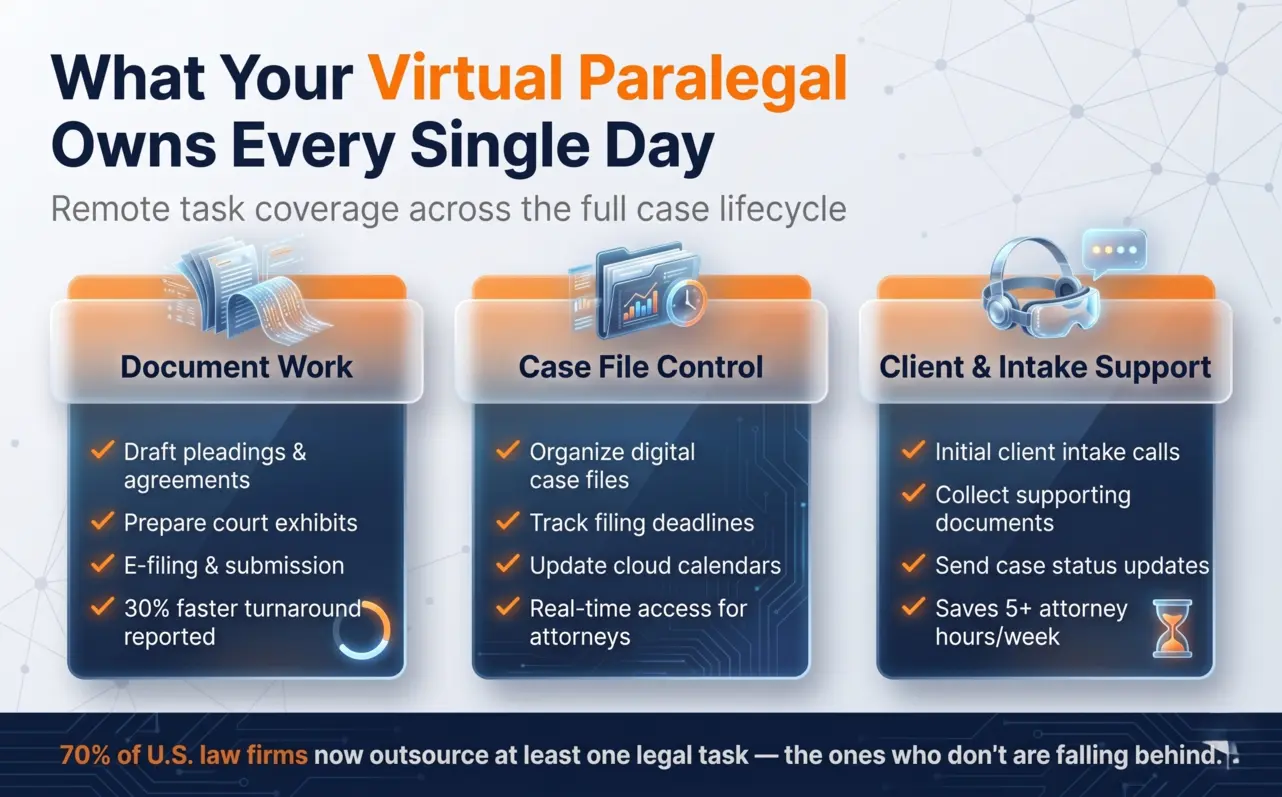
Reports claim that 70% of U.S. law firms outsource legal or administrative tasks because remote paralegals make attorneys’ work much easier. To understand this better, here’s a breakdown of the key case management tasks virtual paralegals handle.
1. Document Preparation and Filing
Virtual paralegals take care of drafting pleadings, agreements, and court documents. They also prepare exhibits, organize evidence, and assist with e-filing. In many cases, firms report up to 30% faster document turnaround after using remote support.
For example, in a workers’ compensation case, a virtual paralegal can gather medical reports, prepare DWC claim forms, and organize wage records quickly, helping attorneys file on time and meet deadlines without delays.
2. Case File Management and Tracking
Case file management is one of the most time-consuming tasks. But, virtual paralegals make that work also easier. They organize documents, update case timelines, and maintain digital records using legal software. It’s made sure that every document, note, and deadline is easy to access.
These tasks include:
- File organization
- Deadline tracking
- Calendar updates
Since they work remotely, everything is updated in cloud systems, making case details available in real time.
3. Client Communication and Intake Support
Virtual paralegals can also do the client intake, follow-ups, and routine updates. They can also do the initial calls, collect documents, and keep clients informed about case progress.
A news report states that a family law attorney reported gaining five extra working hours per week after delegating client communication tasks.
How Virtual Paralegals Maintain Deadline Integrity and Timeline Control Across Multiple Active Cases
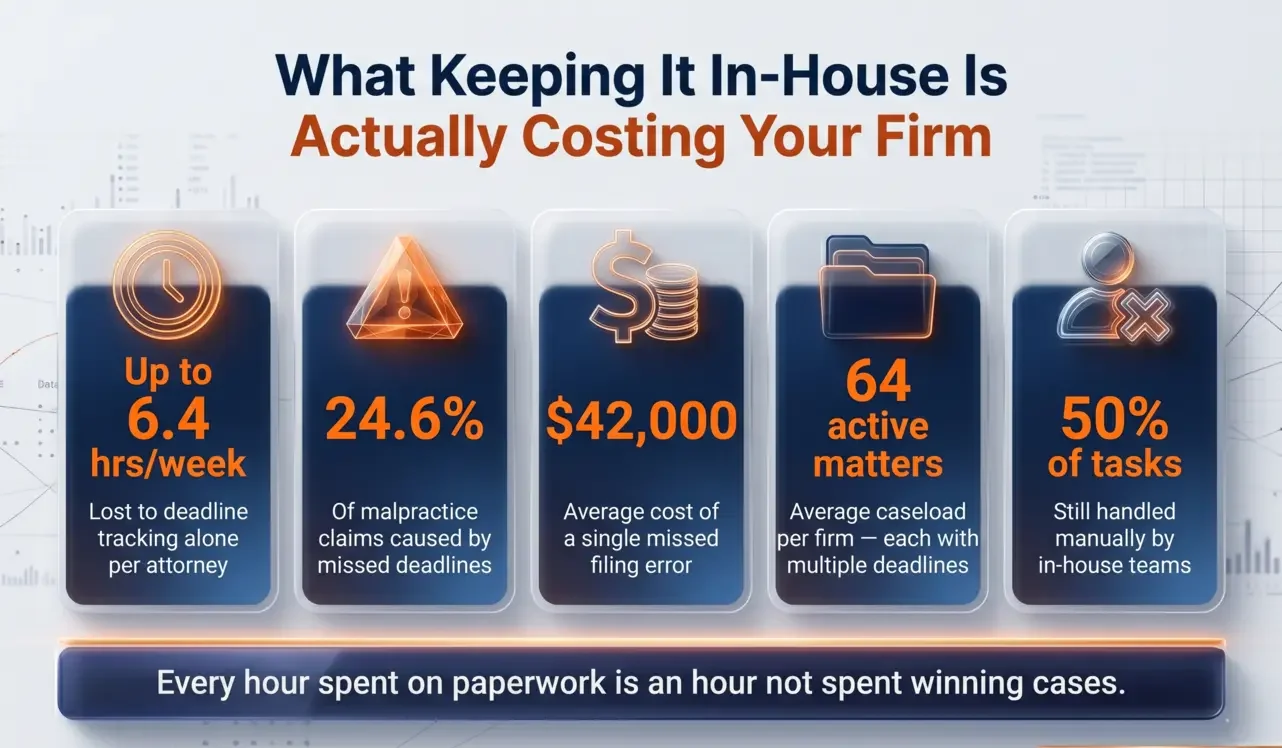
Handling deadlines across multiple cases is one of the biggest pressure points for U.S. law firms. On average, a firm manages around 64 active matters at a time, each with several key deadlines, which quickly adds up to hundreds of dates to track.
At the same time, deadline-related mistakes account for nearly 24.6% of malpractice claims, making it the single largest risk area. Even a single missed filing can cost about $42,000 on average. This is where virtual paralegals step in, helping firms stay on track without adding more in-house pressure.
Structured Tracking Instead of Basic Calendars
Virtual paralegals don’t just mark dates they track the full chain of tasks behind each deadline. A filing deadline depends on document collection, drafting, review, and client approval. When any step slows down, the deadline is at risk. Many firms miss deadlines not because dates are unknown, but because these steps are not tracked properly.
Real-Time Follow-Ups and Workload Control
Virtual paralegals manage ongoing follow-ups across all active cases, ensuring nothing gets overlooked. Manual systems miss about 3.2% of deadlines yearly, while structured tracking reduces this to below 0.1%.
They also reduce time spent on deadline management from about 6.4 hours per week to nearly 1 hour when systems are properly handled. Hence, attorneys end up spending less time checking status and get the time to build case-winning strategies.
How On-Demand Paralegal Services Provide Scalable Case Management Capacity Without Long-Term Commitment
In many U.S. law firms, case workloads don’t stay steady. Some months are quiet, while others bring a sudden rush of filings, client updates, and deadlines. This is where on-demand paralegal services are becoming a practical option.
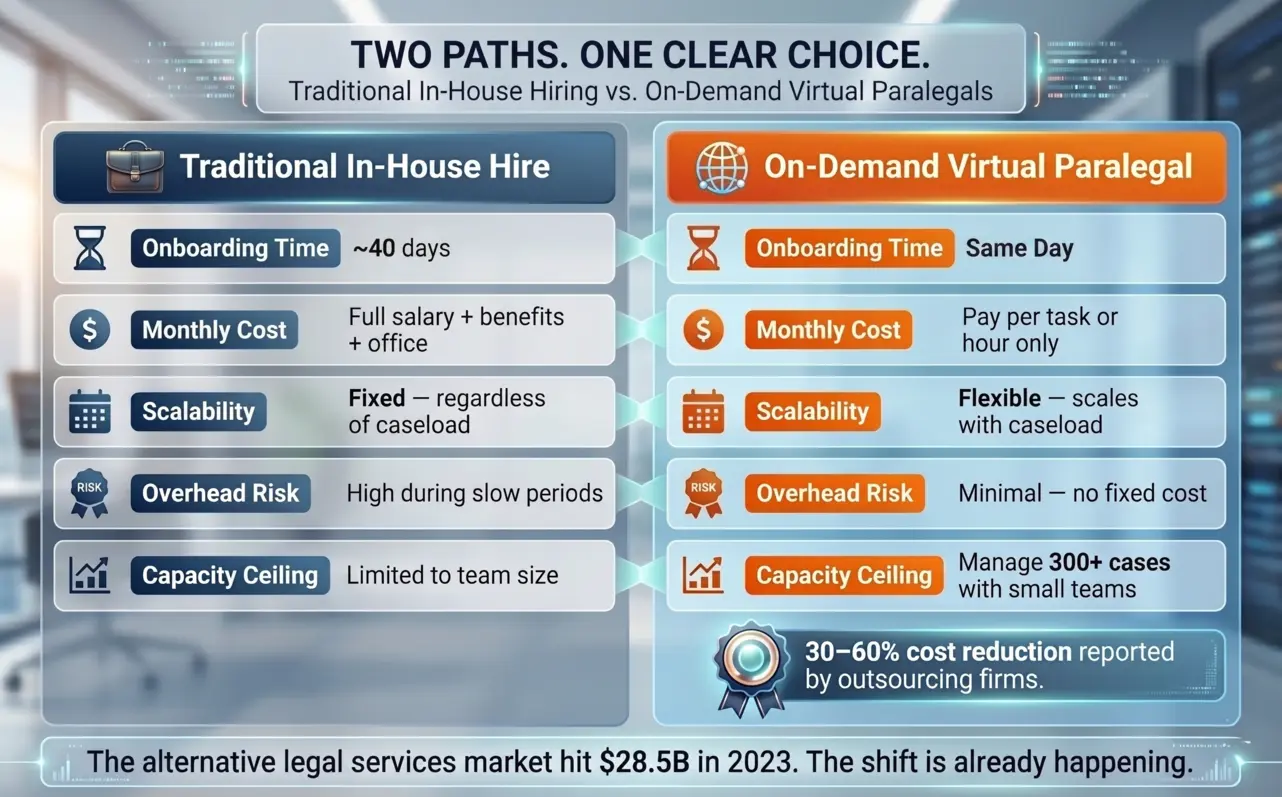
Recent industry data shows that the alternative legal services market reached $28.5 billion in 2023, growing rapidly as firms look for flexible support instead of full-time hiring . In fact, about 70% of law firms now outsource at least one legal task, such as document handling or case support work. Another report shows that outsourced legal support can reduce costs by 30% or more, mainly because firms avoid long-term salaries and overhead expenses.
On-demand paralegals help law firms scale case management up or down depending on workload. Instead of hiring full-time staff, firms can assign tasks like:
- Drafting case documents
- Organizing discovery files
- Updating case management systems
- Client communication follow-ups
Let’s understand with a simple example. A small personal injury firm handling 25 cases a month may suddenly receive 60 cases during a marketing push. Hiring a new paralegal can never be a good solution.
But, instead, you can hire virtual paralegals for that busy period so that they complete the workload, and scale back when things slow down. So, this makes law firms more flexible and allows them to monitor their costs while they take up new caseloads.
How Virtual Paralegals Operate Within Your Existing Legal Case Management Infrastructure?
Virtual paralegals work by plugging into a law firm’s existing case management system instead of replacing it. Most U.S. firms now use cloud tools like MyCase or PracticePanther, where case files, deadlines, and client notes are stored in one place. Firms using digital case management systems along with remote support report up to 30%–35% reduction in time spent on document processing and case file handling.
Law firms have noticed that when they outsource legal support, costs go down by 30%–60% when compared to in-house staffing, because attorneys do not have to worry about office space or full-time salary involved.
Let’s see a real-life example;
Imagine a personal injury firm in Texas handling 80 active cases. A virtual paralegal uses the same system to review medical records, update case timelines, draft demand letters, and upload documents directly into the case folder. The attorney sees everything in real time and only focuses on strategy and court work.
Turnaround time also improves. Some firms report reducing onboarding delays from around 40 days to under 10–14 days when using virtual staffing instead of hiring in-house.
In simple terms, virtual paralegals don’t change your system they make it faster, lighter, and easier to manage daily case work.
Measuring the Operational and Financial Impact of Virtual Paralegals on Your Firm’s Case Management Efficiency
Virtual paralegals tend to improve case management efficiency by reducing costs, saving time, and increasing overall case handling speed for U.S. law firms. Studies show that firms using remote legal staff cut operational expenses by 40–70%, mainly because they avoid office space, benefits, and full-time salaries.
On the operational side, firms that opt for virtual paralegals report around around 25%–40% improvement in task turnaround speed for routine case work like drafting and filing. Many firms also report that remote staffing helps them manage up to 300+ cases with smaller teams, improving productivity without hiring extra in-house staff.
1. Faster Case Processing
Virtual paralegals are familiar with e-filing, document review, and case tracking using cloud tools. It is said that digital case tracking tools combined with remote support reduce email and internal coordination time by nearly 50% per case. This reduces delays because work is updated in real time instead of waiting for office coordination.
2. Lower Financial Pressure
Virtual paralegals do not demand full-time salaries but only for the tasks or hours they have worked. This way, firms can control their revenue and avoid overstaffing.
For example, if a mid-sized law firm is managing 200 personal injury cases and it assigns medical record sorting and document drafting to virtual paralegals, automatically, attorneys get to focus only on client strategy and court work. This balance improves both speed and revenue efficiency.
Key Evaluation Criteria for Selecting A Qualified Virtual Paralegal for Case Management Responsibilities
A qualified virtual paralegal for case management is usually selected based on experience, legal knowledge, and ability to work with digital tools. In the U.S., this role has grown quickly as law firms shift to remote support systems. Recent data shows that attorneys end up saving 6+ working hours when virtual paralegals take up the paperwork, showing how common this setup has become.
Taking virtual paralegals into consideration, almost 60% of the U.S law firms say that this flexible staffing helps them take up more cases, increasing their revenue tremendously.
Some of the qualities a qualified virtual paralegal should have are discussed below;
1. Legal Knowledge & Case Handling Experience
A strong candidate should understand legal drafting, document review, and case flow. They must be comfortable handling structured case files and deadlines.
2. Technology & Communication Skills
Virtual paralegals should be aware of case management softwares, cloud storage, and secure communication platforms approved by U.S. firms.
Eligibility Criteria
- Paralegal certification or associate degree
- 2–3 years legal support experience
- Knowledge of U.S. legal procedures
- Strong written communication skills
- Ability to manage multiple cases remotely
- Familiarity with tools like PACER and legal software
Conclusion
Virtual paralegals have completely changed case management for U.S. law firms. Drafting, filing, and deadline tracking have now become faster and more organized. Studies show that around 82% of paralegals work remotely and this is the reason why firms save up to 40% in costs. This shift helps lawyers focus more on legal work instead of routine paperwork.
Law firms can also get support from LPO Giant for virtual paralegal and on-demand paralegal services. Their team helps with case files, deadlines, and client updates in a simple way. This makes daily work smoother, reduces pressure on attorneys, and supports better case management resulting in overall efficiency of your firm.
Try LPO Giant’s Free Pilot Project And Experience Their Working Style!

Try Free Pilot Project