


Why Bankruptcy Filings Are Surging In 2026 And What Law Firms Must Do Now
Bankruptcy filings didn’t slow down even after 2025’s 11% rise. Total filings reached 574,314 in the twelve months ending December 2025, and the momentum has only accelerated, with Q1 2026 recording 150,009 cases, a 14% jump over the same period last year. Higher interest rates, rising living costs, mounting household debt nearing $18.8 trillion, and slower business income are the main forces behind this wave.
As bankruptcy filings in 2026 continue to climb, law firms are running out of time to handle paperwork, upload documents to PACER, and communicate timely updates to clients. Rather than expanding full-time headcount, firms have started opting for flexible staffing or choosing outsourcing as a strategic option. Let’s look at what is driving the rise and how attorneys can respond before it overwhelms their operations.
How Have Bankruptcy Filings Grown From 2023 to 2026?
Before diving into the causes, here is what the numbers look like across four years, sourced directly from USCOURTS.gov and Epiq AACER.
| Year | Business Filings | Non-Business Filings | Total Filings | YoY Change |
| 2023 | 18,926 | 434,064 | 452,990 | +16.8% |
| 2024 | 23,107 | 494,201 | 517,308 | +14.2% |
| 2025 | 24,737 | 549,577 | 574,314 | +11.0% |
| 2026 (Q1: Jan-Mar) | 8,436 commercial | 141,573 consumer | 150,009 | +14.0% |
Sources: USCOURTS.gov 2023 Filing Data | USCOURTS.gov 2025 Annual Data | Epiq AACER Q1 2026 Report | G2 Risk Solutions March 2026 | USCOURTS.gov Q1 2026 Quarterly Data
The data makes one thing clear: this is not a temporary spike. The bankruptcy surge 2026 law firms are navigating to the continuation of a multi-year climb. As Michael Hunter, Vice President of Epiq AACER, stated in April 2026: “The first-quarter numbers paint a clear picture: bankruptcy filings are up 14% overall, driven by a 67% jump in Subchapter V elections and solid increases in both commercial and consumer cases.”
What Economic Trends Are Driving The Rise In Bankruptcy Filings?
Household debt in the U.S. has climbed to nearly $18.8 trillion, and delinquency rates have worsened to 4.8% across outstanding balances in late 2025, with notable upticks in credit card, mortgage, and student loan delinquencies. With inflation persisting alongside elevated interest rates, the pressure of managing personal and business finances is building fast on households across the country.
Cost Pressure
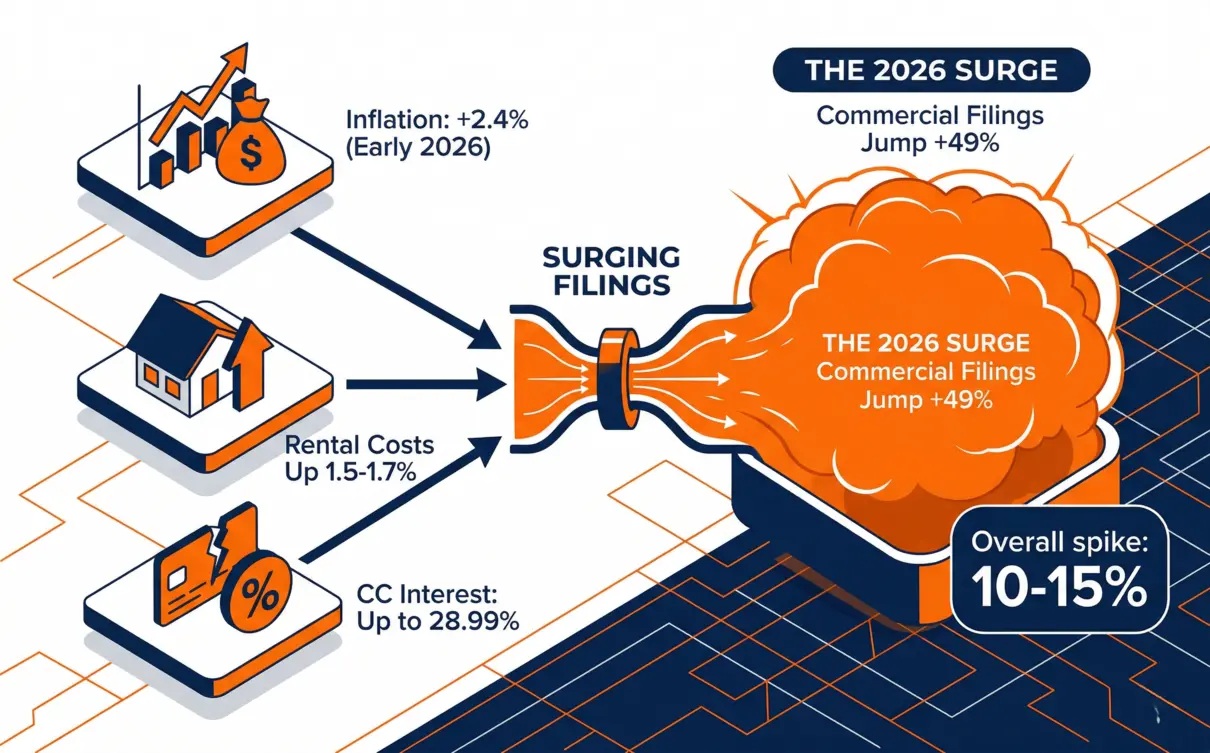
The cost of living is rising faster than individual income. The U.S. is seeing an increase of about 1.5%-1.7% in rental costs from 2025 to 2026, adding consistent pressure on household budgets. The result is a familiar cycle: people lean on credit cards for everyday expenses and then fail to repay the accumulating debt. This pushes individuals to file Chapter 7 liquidation or enter Chapter 13 repayment plans.
High Interest Burden
Credit card interest rates are making filing bankruptcy an increasingly unavoidable consideration for struggling borrowers. In 2025, Capital One Financial Corp was charging 26.99% interest, which increased to 28.99% in 2026. The consequences compound every month:
- Balances are growing faster than people can repay them
- Many borrowers only cover the minimum interest each month
- Monthly expenses are becoming harder to absorb
- High rates are pushing more people toward filing for bankruptcy
How Are These Trends Shaping The Biggest Legal Industry Challenges?
These trends are creating serious operational problems for law firms. More bankruptcy filings 2026 means more cases, more documents, and stricter deadlines arriving simultaneously. The biggest legal industry challenge is how much pressure daily workflows can realistically absorb before quality begins to break down.
Here are the core law practice industry challenges that bankruptcy surge 2026 law firms are facing.
Volume vs. Capacity
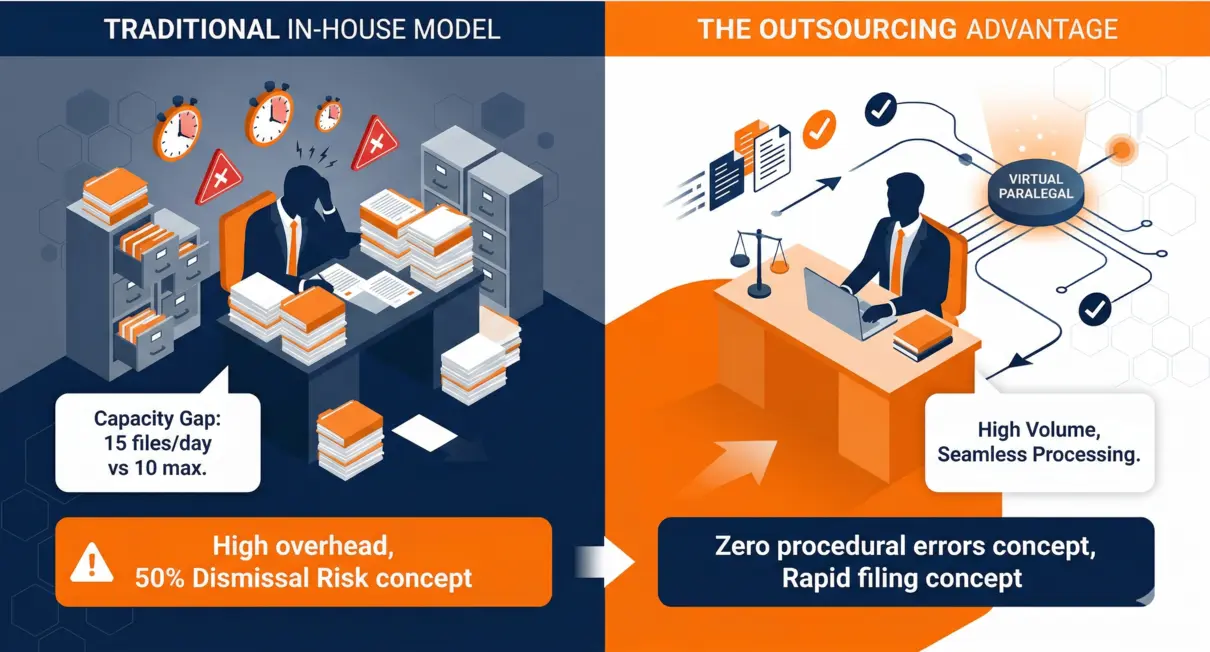
Imagine reviewing 15 files a day when your team can only handle 10. This strains work quality and raises the probability of errors. Common symptoms firms are already reporting include:
- Intake sheets with incomplete or inconsistent data
- Confusion about which motions or notices need to be prepared per case
- Backlogs in petitions, motions, and notice filings building week over week
Time Pressure
Deadlines in bankruptcy cases begin almost immediately after filing. The meeting with creditors typically happens 20-40 days after the petition is filed, and other key steps must be completed on schedule or the case risks delay or dismissal. Attorneys managing large caseloads have very little margin for administrative delay.
Error Risk
National data shows a 47.9% dismissal rate for filing bankruptcy chapter 13 cases, with leading causes including failure to submit required documents, missing the initial plan payment, and not attending the 341 hearing. The national average masks sharp district-level variation: some districts see dismissal rates above 90%, while well-managed firms in the same courthouse achieve rates as low as 20%. The difference, according to case data, is almost entirely explained by case management practices, not debtor profiles.
What Are The Next Big Challenges For Bankruptcy Surge 2026 Law Firms?
In January 2026 alone, total bankruptcy filings reached 45,808, a 10% increase over January 2025’s 41,551. Commercial Chapter 11 filings jumped 76% year-over-year that month, the highest January level for commercial filings since 2018. By March 2026, total monthly filings reached 58,278, a 16% year-over-year increase. The real challenge in 2026 is not just more bankruptcy filings. It is handling every case accurately, faster, and under tighter pressure than last year.
More Complex Cases
Bankruptcy cases have become more complicated because clients now carry multiple types of debts, businesses, or properties. Extra documents and additional steps are making case preparation far more demanding. Attorneys must now routinely handle:
- Multiple properties, motor vehicles, and household goods across different schedules
- Personal liens, priority and non-priority debts, and business loans in the same case
- Tax returns, bank statements, and multiple income sources requiring cross-verification
- Filing bankruptcy chapter 7 or chapter 13 schedules, repayment plans, and court forms submitted under strict deadlines
Cost Control Issues
Law firm technology spending grew 9.7% in 2025, the fastest real growth ever recorded in the legal industry, according to the 2026 Thomson Reuters and Georgetown Law State of the US Legal Market Report. Simultaneously, direct spending on lawyer compensation jumped 8.2%, according to Thomson Reuters’ January 2026 press release. The budget pressures on law firms are stacking up on both ends:
- Rising case numbers demand better bankruptcy filing case management software
- The U.S. government’s prioritization of e-filing requires firms to keep tools current
- More work means hiring extra staff, which increases salaries and benefits
- Clients want faster turnarounds, pushing ongoing investment in both technology and specialized attorneys
Sources: Thomson Reuters Law Firm Rates Report 2026 | Thomson Reuters Press Release, January 2026
How Are Client Expectations Changing In Bankruptcy Cases?
In 2026, clients want quick updates, clear costs, and digital access from the moment they decide on filing for bankruptcy. A small business owner receiving weekly status messages, understanding every next step, and seeing all expenses laid out upfront is not an unusual expectation. It is quickly becoming the baseline.
Clear Costs, No Surprises
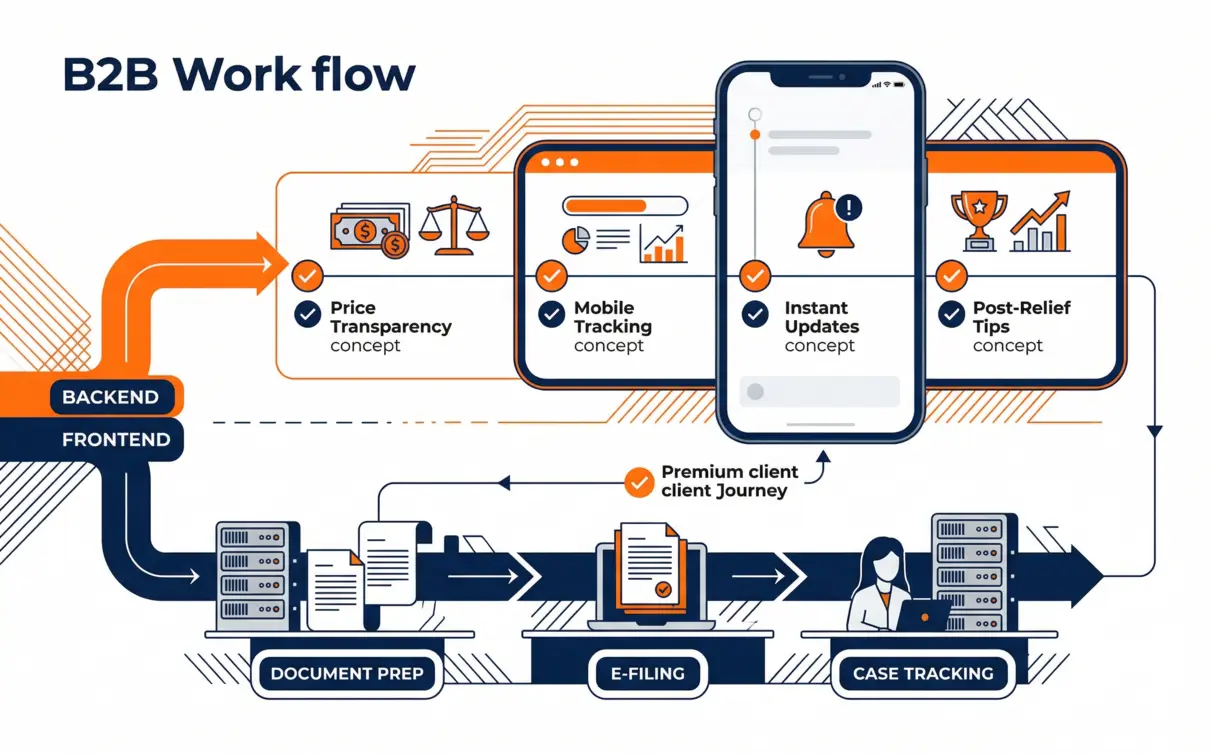
Clients actively compare firms before committing. Their first questions are: “What is the total cost? What is covered? What is the timeline?” For example, when comparing two firms where one charges a significantly higher fee for filing bankruptcy chapter 13, most clients will choose the more transparent, lower-cost option even if the difference is a few hundred dollars. Transparency is no longer a courtesy but a competitive requirement that directly affects case acquisition.
Digital-First Experience
Clients expect everything accessible on their phones: when forms are due, when court hearings are scheduled, and when debts may be discharged after filing for bankruptcy chapter 7 or chapter 13. They also want post-filing resources on fixing credit, recovering assets, and planning next steps available digitally without calling the office. Firms investing in client portals and automated case update systems are already seeing higher client retention and fewer inbound status calls, freeing paralegal time for actual case work.
What Are The Key Challenges For In-House Legal Teams Under Pressure?
The key challenges for in-house legal teams come from clients, courts, and growing paperwork volumes simultaneously. According to the Clio Legal Trends Report, 79% of legal professionals are now using AI tools in 2025, up dramatically from just 19% in 2023, reflecting how urgently firms are looking for ways to manage workload without adding headcount.
For many firms, the reality is a single paralegal preparing bankruptcy motions, creditor notices, PACER filings, and court deadline tracking while also handling client communication. That same team member is expected to cut costs while taking on more work, leaving little room for the careful review that complex bankruptcy filing cases require. Attorneys are simultaneously expected to function as legal strategists, client managers, and firm risk officers, all roles that become impossible to balance when case volume outpaces capacity.
How Is Rising Case Volume Affecting Law Firms’ Profits And Efficiency?
Rising bankruptcy filings mean more revenue at the top line but shrinking margin at the bottom. Thomson Reuters data shows billable hours increased 2.5% industry-wide in 2025, peaking at 4.4% in July, reflecting genuinely strong demand. But with technology spending up 9.7% and talent costs up 8.2% in the same period, firms are investing heavily just to keep pace with the workload. The profit per case is declining even as total revenue grows.
The clearest sign of this efficiency problem: firms are reinvesting case revenue directly back into the software and staff needed to process the next wave of bankruptcy filings 2026. For bankruptcy practices specifically, where flat-fee and low-margin work dominates, every additional hour spent on administrative preparation is an hour that does not contribute to the firm’s profitability.
How Are Law Firms Responding To The Bankruptcy Surge 2026?
As bankruptcy filings 2026 continue to break records, the traditional model of hiring full-time staff for every caseload spike is no longer financially practical. Firms are responding with three main strategies.
Flexible Staffing Models
Rather than committing to permanent hires, firms are contracting paralegals and legal assistants through legal staffing platforms and freelance paralegal networks on a per-case or per-month basis. This keeps fixed headcount lean while ensuring coverage during peak periods of filing for bankruptcy chapter 7 and filing bankruptcy chapter 13 cases.
Technology Adoption
Firms are investing in bankruptcy-specific case management platforms such as Best Case, TurboLaw, and Clio to automate deadline tracking, form generation, and PACER uploads. These tools reduce procedural errors and free attorneys to focus on legal strategy rather than document assembly. According to the American Bar Association’s 2024 Legal Technology Survey, 30% of private law firms have now adopted AI technology, nearly triple the 11% adoption rate in 2023, with larger firms above 100 attorneys reaching 46%.
Outsourcing Bankruptcy Work
An increasing number of firms are outsourcing bankruptcy filing work to specialized legal process outsourcing providers. This approach is gaining traction because it combines cost control with immediate access to experienced paralegals who already understand bankruptcy schedules, creditor matrices, PACER filing requirements, and court-specific procedures. Outsourcing allows firms to handle higher volumes of filing bankruptcy chapter 7, filing bankruptcy chapter 13, and all related work without burning out internal teams or creating the procedural errors that lead to dismissals.
What Smart Steps Can Law Firms Take Now To Manage The Surge?
The right steps should help firms handle cases without added stress, keep work organized, and meet every court deadline without fail. Here is a practical checklist:
- Focus on profitable or urgent cases first and assign them to the most experienced team members
- Track onboarding speed from intake to first bankruptcy filing and eliminate delays at every step
- Keep client communication structured, short, and on a consistent schedule
- Break case preparation into repeatable, standardized workflows for each bankruptcy chapter
- Use a dedicated bankruptcy case management tool such as Best Case or Clio to centralize deadlines and documents
- Monitor team capacity proactively and redistribute work before overload builds
- Outsource document preparation, creditor matrix assembly, and research to free attorney time
- Review case progress weekly and adjust workflows based on what is slowing the team down
- Monitor all court deadlines daily to avoid the procedural dismissals that cost firms time and client trust
Conclusion
The bankruptcy surge 2026 law firms are navigating and it’s not just a volume problem. It is a structural challenge that touches staffing, technology, client experience, and profitability at the same time. Whether your team is managing a handful of new cases or processing dozens each week, the administrative burden of filing bankruptcy chapter 7 and filing bankruptcy chapter 13 compounds fast when processes are not built to scale.
Firms that respond proactively by streamlining workflows and bringing in specialized support will protect their margins and their reputation. Firms that wait risk case dismissals, client dissatisfaction, and burnout among their best people. With Q1 2026 already recording 150,009 bankruptcy filings at a 14% year-over-year increase, the window to get ahead of this surge is now, not later.
The smartest move right now is to start with a low-risk, no-commitment test.
At LPO Giant, we support law firms and attorneys with reliable, fast, and accurate bankruptcy paralegal services. Our experienced virtual paralegals handle petitions, schedules, creditor matrices, PACER uploads, and all supporting documentation, so your attorneys can focus on legal strategy and client relationships.
Try Our Free Pilot Project and See How LPO Giant Works!