How Virtual Paralegal Services Help Bankruptcy Law Firms Handle More Cases


Bankruptcy law has changed rapidly over the past decade. Before 2011, client details, petitions, and even communications were handled manually, with each attorney supported by 2–5 paralegals. Between 2010–2020, cloud software like Clio and e-filing on PACER made work faster and more organised. By 2024, nearly 68% of law offices used online systems to keep client records safe.
Right now, bankruptcy paralegal services handle everything from debt lists to tax records taken straight from programs like BestCase, NextChapter, or JubileePro. Studies show that 36% of offices now rely on AI tools or chatbots to gather client details automatically. This saves all the answers without needing any human effort.
In this article, we discuss the key bottlenecks slowing bankruptcy law firms down. We also explain how virtual bankruptcy paralegal services help attorneys take on more cases without growing their in-house overhead.
Why Bankruptcy Caseloads Are Rising Faster Than Firms Can Scale
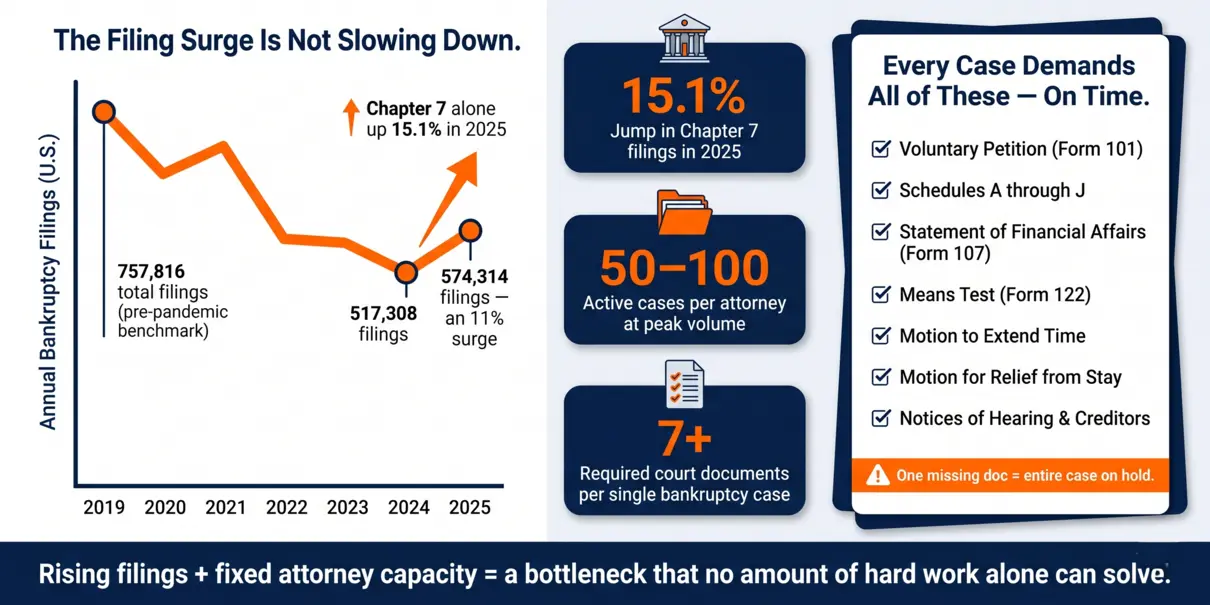
Rising inflation, higher cost-of-living, sudden increases in interest rates, and personal financial hardship are all driving a surge in bankruptcy filings. Chapter 7 filings jumped 15.1% in 2025. Even with modern technology available, case volume has outpaced the capacity of most firms to grow at the same pace.
Bankruptcy work is document-heavy by nature. Every individual case requires multiple documents that must be prepared accurately and filed on time. At the 341 meeting, trustees expect every single document to be complete and 100% correct. The primary details required for a complete Bankruptcy Petition are:
- Voluntary Petition (Form 101)
- Schedule A to J covering assets, liabilities, creditors, income, and expenses
- Statement of Financial Affairs (Form 107)
- Statement of Current Income / Means Test (Form 122)
Along with the petitions, some bankruptcy cases also demand extra motions and notices. These must be submitted on very strict schedules to prevent the court from closing the case early:
- Motion to Extend Time to File Schedules or Statements
- Motion for Relief from Stay
- Notice for Meeting of Creditors
- Notice of Hearing on Motion
Just a single delay document or a slow response from the client can hold up the whole process. Multiply that across 50 to 100 active cases, scale of the problem becomes very obvious.
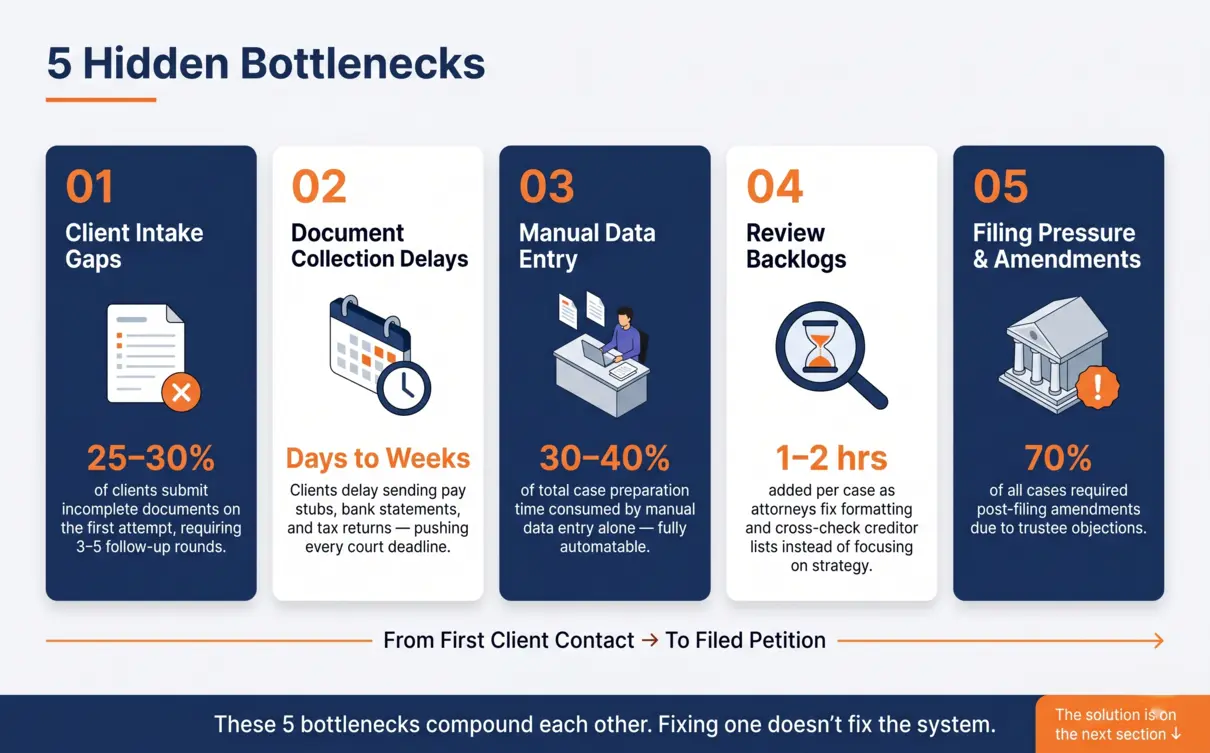
The Hidden Bottlenecks Slowing Down Petition Preparation and Filing
Law firms report that petition preparation and filing is often slowed down by manual data entry errors, missing or incomplete client information, repeated document reviews, and paper-based processes. These tasks take 30 to 40% longer than the actual filing procedure, putting a serious question mark over a firm’s efficiency.
- Client Intake Gaps
Missing pay stubs, tax returns, or incomplete questionnaires delay petition drafting. Many firms report needing 3 to 5 follow-ups before client files are complete. In some cases, 25 to 30% of clients submit incomplete documents on the first attempt, stalling the start of the case.
- Document Collection Cycles
Clients often take days or weeks to send records. Even repeated reminders do not always get documents in on time. Each delay pushes filing timelines and puts pressure on deadlines for Chapter 7 and Chapter 13 filings.
- Data Entry and Form Preparation
Preparing schedules of assets and liabilities, statements of financial affairs, and means test details takes hours per case. Even small errors in numbers or dates require rework. Manual data entry accounts for 30 to 40% of total preparation time in high-volume firms.
- Review Backlogs
Attorneys spend time fixing formatting, verifying numbers, and cross-checking creditor lists instead of focusing on strategy or client counseling. Reviewing and correcting petitions can add 1 to 2 hours per case.
- Filing Pressure
Tight court deadlines increase the chances of last-minute corrections before filing. A single error may cause the trustee to reject the petition, requiring amendments that delay the entire process. Nearly 70% of bankruptcy cases filed have required amendments due to trustee objections.
What Tasks Can a Virtual Paralegal Handle for Bankruptcy Attorneys?
Virtual bankruptcy paralegals are trained legal professionals who work remotely to manage the full document lifecycle of a bankruptcy case, always under direct attorney supervision. Here is what they can take off your plate:
Petition Preparation
- Drafting complete Chapter 7 and Chapter 13 legal forms using BestCase, NextChapter, or JubileePro
- Prepare Schedules A to J, the Statement of Financial Affairs, and the Means Test (Form 122)
- Pull creditor lists, tax return details, and financial documents directly from case management software
Amendments and Corrections
- Prepare and file amended schedules when trustee objections arise
- Track amendment deadlines and flag required changes to the supervising attorney
- Correct errors in creditor matrices, income schedules, or asset disclosures
Trustee Communication Support
- Compile document packets for 341 meeting preparation
- Respond to trustee document requests under attorney direction
- Coordinate timely submission of additional evidence or clarifications
Motions and Notices
- Draft Motion for Relief from Stay, Motion to Extend Time, and other standard motions
- Prepare Notices of Hearing and Meeting of Creditors with accurate court-specific formatting
- File documents through PACER or CM-ECF and track confirmation receipts
Client Follow-Up and Intake
- Send structured follow-up requests for missing pay stubs, bank statements, and tax returns
- Use online intake forms or chatbot-collected data to pre-populate bankruptcy forms
- Organize all incoming client documents into the case management system
By handing these tasks to experienced bankruptcy paralegals, attorneys can save 30 to 50% time on every case and allow them to take 40% more clients.
Why Hiring More Staff Is Not the Answer to Backlog Problems
Hiring more in-house staff is often the first instinct when caseloads rise, but it is rarely the most efficient fix. The real problem in most firms is process inefficiency, not headcount. Integrated tools like BestCase, NextChapter, and Clio already let one attorney handle twice as many cases when supported by the right paralegal structure.
Automated petition drafting and e-filing can cut document preparation time by 30 to 80%. The key is pairing that technology with trained paralegal bankruptcy support that scales with your caseload rather than fixed monthly salaries that add to overhead whether cases are coming in or not.
Quick Comparison of In-House Paralegal and Virtual Bankruptcy Paralegal
| Cost Factor | In-House Paralegal | Virtual Bankruptcy Paralegal |
| Monthly Cost | $5,000 to $8,000 per month | $10 to $20 per hour |
| Benefits and Insurance | 20 to 30% added on top | Not applicable |
| Office Space and Equipment | $500 to $1,500 extra per month | None required |
| Training Period | 4 to 5 months, $3,000 to $10,000 | Minimal, already trained |
| Scalability | Fixed headcount | Scale up or down as needed |
| Annual Cost (Estimate) | $72,000 to $110,000 or more | A fraction of that, billed as used |
Virtual bankruptcy paralegal services give firms access to trained professionals at 40 to 70% lower cost than hiring in-house, with no long recruitment cycles and no benefits overhead.
How LPO Giant’s Virtual Paralegal Team Works
We follow a structured, attorney-supervised workflow that keeps your firm in full control at every step.
Step 1: Client Intake and Document Collection
Your office shares the client questionnaire, the signed contract, and the first batch of papers into a safe online folder. Our virtual bankruptcy paralegals carefully check this whole file to make sure nothing is missing. They will quickly point out any lost wage slips, tax papers, or bank records before they even begin typing.
Step 2: Petition Drafting
Our paralegals prepare the full bankruptcy petition using your preferred software, whether that is BestCase, NextChapter, or JubileePro. Schedules A through J, Statement of Financial Affairs, and Means Test forms are all completed to court standards.
Step 3: Internal Quality Check
Every completed petition goes through an internal review before it reaches your desk. The quality check covers form accuracy, schedule consistency, creditor list completeness, and format compliance, reducing the risk of trustee objections significantly.
Step 4: Attorney Review and Delivery
The reviewed petition package is delivered to the attorney with a brief summary of any flagged items or follow-up questions. The attorney reviews, approves, and signs. No surprises at the 341 meeting.
Step 5: Post-Filing Support
After filing, our team supports amendment preparation, trustee document requests, and deadline tracking so your team stays on top of every active file without losing bandwidth.
How Law Firms Can Improve Intake, Document Collection, and Case Prep
Bankruptcy paralegal services work best when paired with clear internal workflows. Firms using BestCase or NextChapter report 30 to 40% faster petition preparation and 50% fewer mistakes in schedules and forms. Here is how your firm can improve:
- Use structured online intake forms or chatbots to collect asset, debt, and income details
- Store client files in cloud portals like MyCase, LawPay, Filevine, or Zola Suite for easy access
- Pull creditor and tax return data directly from BestCase or equivalent software
- Pre-check all documents for completeness before petition drafting begins
- Track case milestones in your case management system to hit every court deadline
Which Bankruptcy Tasks Can You Safely Delegate Without Losing Oversight?
Bankruptcy attorneys can safely hand off everyday tasks, like bringing on new clients, handling the paperwork, and tracking deadlines, to trained bankruptcy paralegals while still staying in complete control. A skilled virtual bankruptcy petition preparer can fill out all the main bankruptcy forms, leaving the attorney to just review and sign off on the final documents. Studies show that law firms doing this save 30% to 50% of their attorneys’ time and can take on up to 40% more cases, all without having to hire full-time staff.
Conclusion
Bankruptcy filings in the U.S. are expected to keep rising, and attorneys will continue to face increasing pressure on their time and resources. Chapter 7 and Chapter 13 cases involve a massive amount of paperwork that has to be filed perfectly and right on time.
That is why many law firms team up with LPO Giant for reliable virtual bankruptcy paralegal services. Our trained paralegals take care of drafting petitions, preparing schedules, making updates, talking with trustees, and tracking down documents. We work across different time zones, so your cases keep moving forward around the clock.
Our services are affordable and completely flexible, letting you scale up or pause whenever your needs change. Want to see what we can do for your firm? Try our Pilot Project and experience our work for yourself.

Try Free Pilot Project